Blog

  • Reaping the open source benefit for Wales

    Reaping the open source benefit for Wales

    Digital infrastructure and services underpin much of our modern existence. In work and leisure, with family and friends, we inhabit – to ever-greater extents – a digital world. This world, much like the ‘real’ world, is characterised by huge disparities in access and opportunities.

    Many digital opportunities are jealously guarded by global corporations that create walled gardens within which we communicate, share, and create huge wealth for others.

    However, if we scratched just a tiny bit below the surface, we would see that there are myriad opportunities available to almost everyone, if we could only understand how to take advantage of them.

    In Afallen’s first White Paper, published at today’s inaugural meeting of the Senedd Cross-Party Group on Digital Rights and Democracy, we set out why Wales must take advantage, not just of the digital opportunities through adopting different technologies, but in the fundamentals that underpin the digital world.

    Free and Open Source Software (FOSS) underpins the majority of global digital infrastructure, from the WordPress platform that underpins nearly half of global websites, to Apache and Nginx servers carrying more than half of global web servers, to the mushrooming sector of the Internet of Things.

    The economic benefits are huge; a study recently commissioned by the European Commission estimated a return of €4 for every Euro invested into FOSS. That’s partly why the EU has a dedicated open source strategy, and why officials view FOSS as the future for the EU.

    However, there are a whole host of reasons for supporting FOSS, aside from the economic. These include environmental sustainability; equality of access; and better educational and career outcomes.

    Another reason, specific to Wales, is that FOSS is strongly aligned with the Future Generations Goals and Ways of Working. By my reckoning, a FOSS strategy would support no fewer than five of the Goals.
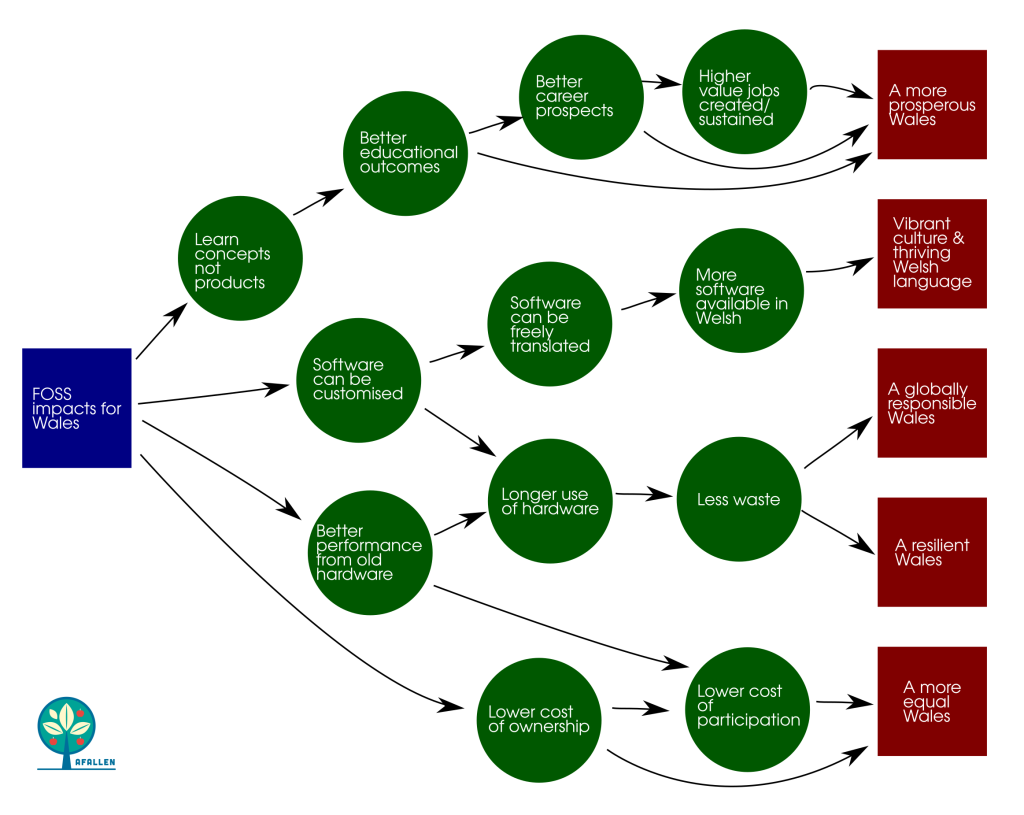
    Systems map showing links between open source impacts, and the Future Generations goals

    But the biggest reason for wanting to champion FOSS is in the field of education. Imagine if learners of all ages in Wales were educated not just in using digital tools; but also steeped in an understanding of the very concepts that will make up the digital tools of the future. We could create a generation of users, producers, hackers and shapers that understand the fundamentals of code, and have the curiousity and the skills necessary to engage, modify and improve on that which has gone before.

    It might seem a tall order; but remember how a Russian cyber-attack first paralysed Estonia, a country of 1.3 million people, and then propelled it to become a global centre of expertise on cyber-security.

    If Estonia can do it, our devolved education system means that we can do the same for FOSS in Wales.

    So what are the next steps for us? In the White Paper I suggest three initial approaches to help embed FOSS within the policy and education landscape in Wales.

    Firstly, our digital strategy needs to explicitly recognise the value in FOSS as a distinct component of ‘digital’ overall. The first anniversary of Wales’ digital strategy is nearly upon us; what better time to reflect on the growing body of evidence, and the policy goals of our nearest economic trading partners, than to incorporate FOSS within the main policy statement for the sector?

    Secondly the Curriculum for Wales should specify FOSS as a component within digital competency, helping pave the way for educators to introduce the concepts and practises of the sector within our learning centres.

    Finally, we must make good use of infrastructure which already exists and is helping to spread good practice in digital across the public sector. The Centre for Digital Public Services could help public sector bodies pilot, and then potentially adopt, FOSS-based ways of doing things that may help with the delivery of a whole host of public goods and services.

    Embracing FOSS will enable the citizens of Wales to not only participate in a rapidly-developing global digital economy with new skills, expertise and confidence; but also to help lift others by contributing to the sum total of human knowledge, freely gifted to all.

  • Afallen welcomes new Partner to accelerate growth in energy sector

    Afallen welcomes new Partner to accelerate growth in energy sector

    Afallen has expanded its partnership to include renewable energy and offshore development consultancy Venn Associates.  

    The appointment is part of Afallen’s continuing growth strategy. Venn Associates is the first new Partner since the company was founded in 2018.

    Commenting on the appointment, Joseph Kidd, founder of Venn Associates said:

    “I am delighted Venn Associates has joined forces with the Afallen team after working with them on a number of sustainability and renewable energy projects over recent years. I am looking forward to being part of a forward thinking team, focussed on helping Wales deliver its net zero ambitions and maximising value for Wales.”

    Joseph will join the three existing Partners, Mari Arthur, David Clubb and Peter Trott to strengthen Wales’ leading sustainability partnership. Joseph brings a wealth of project development and project management experience, as well as significant expertise in the offshore renewables sector in Wales. 

    The addition of Venn Associates will also expand Afallen’s network of associates and presence across Wales.  Afallen works across Wales with a team of associates leading in their own sectors, keeping profits local and helping to keep skilled people working on projects in Wales. 

    Peter Trott feels Venn Associates will add value to existing clients and projects especially work on decarbonisation:

    “Afallen aims to keep work, skills and profit in Wales and to help to grow stronger economies across all regions. We have gone from strength to strength over the last three years and expanding to include a new Partner will mean even more opportunities for Wales.” 

    Mari Arthur added:

    “Having a new partner join us from a new and exciting sector feels like a real boost for Afallen. We look for global best practice and innovation to strengthen what we do in Wales and Venn brings a range of national and international contacts and experience to strengthen our team and our work; helping us develop new ways of making Wales even more sustainable.”

  • Hiraeth Energy; embedding the community in renewable energy

    We are delighted to see that Hiraeth Energy is partnering with Norwegian based Magnora offshore wind to jointly develop two floating wind projects in the Celtic Sea.

    Of course, we would say that; Afallen is a Partner in Hiraeth Energy, and we have been working alongside the other team members to try to make the projects a reality.

    From the start, we wanted to do something different. We wanted to be part of a team based in Wales who all have a personal commitment to maximising the benefits of the projects to Wales.

    That means:

    • Ensuring that a 10% share of both projects is owned on behalf of the people of Wales by a registered Community Benefit Company (or equivalent)
    • Working with partners right across the supply chain to maximise the opportunities for companies, large and small, across Wales
    • Trying to understand and mitigate likely environmental impact and working as closely as possible with environmental organisations to shape the projects

    We’re really pleased that Hiraeth Energy has stood true to those commitments. We’re equally happy that Magnora understands the reasons for us wanting to maximise the benefits for Wales, and is highly supportive of this approach.

    We would love to see Hiraeth Energy successfully develop their floating wind projects, and then consider future Welsh projects – each time challenging themselves and others to increase the proportion that is community-owned. However, that’s probably a fair way off yet. For the time being, we’re just happy to celebrate this next step in community ownership of energy projects in Wales!

  • Hiraeth Energy; gwreiddio cyfran gymunedol mewn ynni

    Rydym yn falch iawn o weld bod Hiraeth Energy yn mynd i bartneru â chwmni gwynt Magnora o Norwy i gyd-ddatblygu dau brosiect gwynt arnofiol yn y Môr Celtaidd.

    Wrth gwrs, byddem yn dweud hynny; Mae Afallen yn Bartner yn Hiraeth Energy, ac rydym wedi bod yn gweithio ochr yn ochr ag aelodau eraill y tîm i geisio gwireddu’r prosiectau.

    O’r dechrau, roedden ni eisiau gwneud rhywbeth gwahanol. Roeddem am fod yn rhan o dîm sydd wedi’i leoli yng Nghymru sydd i gyd ag ymrwymiad personol i wneud y mwyaf o fanteision y prosiectau i Gymru.

    Mae hynny’n golygu:

    • Sicrhau bod cyfran 10% o’r ddau brosiect yn eiddo ar ran pobl Cymru gan Gwmni Budd Cymunedol cofrestredig (neu gyfwerth)
    • Gweithio gyda phartneriaid ar draws y gadwyn gyflenwi i wneud y mwyaf o’r cyfleoedd i gwmnïau, mawr a bach, ledled Cymru
    • Ceisio deall a lliniaru effaith amgylcheddol debygol a gweithio mor agos â phosibl gyda sefydliadau amgylcheddol i lunio’r prosiectau

    Rydym yn falch iawn bod Hiraeth Energy wedi cadw’n driw i’r ymrwymiadau hynny. Rydym yr un mor hapus bod Magnora yn deall y rhesymau pam ein bod eisiau sicrhau’r buddion mwyaf posibl i Gymru, ac yn gefnogol iawn i’r dull hwn.

    Byddem wrth ein bodd yn gweld Hiraeth Energy yn datblygu eu prosiectau gwynt arnofiol yn llwyddiannus, ac yna’n ystyried prosiectau Cymreig y dyfodol – bob tro yn herio eu hunain ac eraill i gynyddu’r gyfran sy’n eiddo i’r gymuned. Fodd bynnag, mae’n debyg bod hynny’n ffordd deg i ffwrdd eto. Am y tro, rydyn ni’n hapus i ddathlu’r cam nesaf hwn mewn perchnogaeth gymunedol o brosiectau ynni yng Nghymru!

  • Welsh learner podcast

    Welsh learner podcast

    Hear about my experience of learning Welsh – and other languages.

  • A worthy infrastructure strategy for Wales

    A worthy infrastructure strategy for Wales

    3–4 minutes

    If I tell you that It’s not often I’ve found myself excited by a piece of infrastructure policy, I’m sure I’ll be in good company. 

    Hold on to your hats; the just-published Wales Infrastructure Investment Strategy (WIIS) is about to smash your concept of what infrastructure policy can mean to the environment, well-being and social justice.

    What can I mean by that? Well, take this direct quote for example:

    “Infrastructure investment programmes must embody the value of social justice and move to eliminate inequality in Wales.”

    It’s true:, this strategy explicitly sets out Welsh Government’s intention to use a strategic approach to infrastructure investment to help tackle social inequality.

    In fact, the themes of social justice, environment and place are embedded throughout the document. There is frequent reference to the foundational economy; to the ‘Town Centre First’ approach; and to green infrastructure and natural solutions. Sustainability runs through the whole thing like electrons in a wire.

    The increasing focus on improving well-being outcomes from infrastructure isn’t ‘just’ a Wales thing. If you look through some other recent infrastructure strategies, such as the New Zealand draft infrastructure strategy, the preliminary stage on Canada’s Infrastructure Assessment, and the 2021 Australia Infrastructure Plan, you’ll see that well-being is becoming less a peripheral ‘bolt-on’ and more a core component and desirable outcome of infrastructure delivery. Indeed – not that we should be evaluating strategies with this sort of metric – Australia’s Plan contains the word ‘sustainability’ no fewer than 614 times.

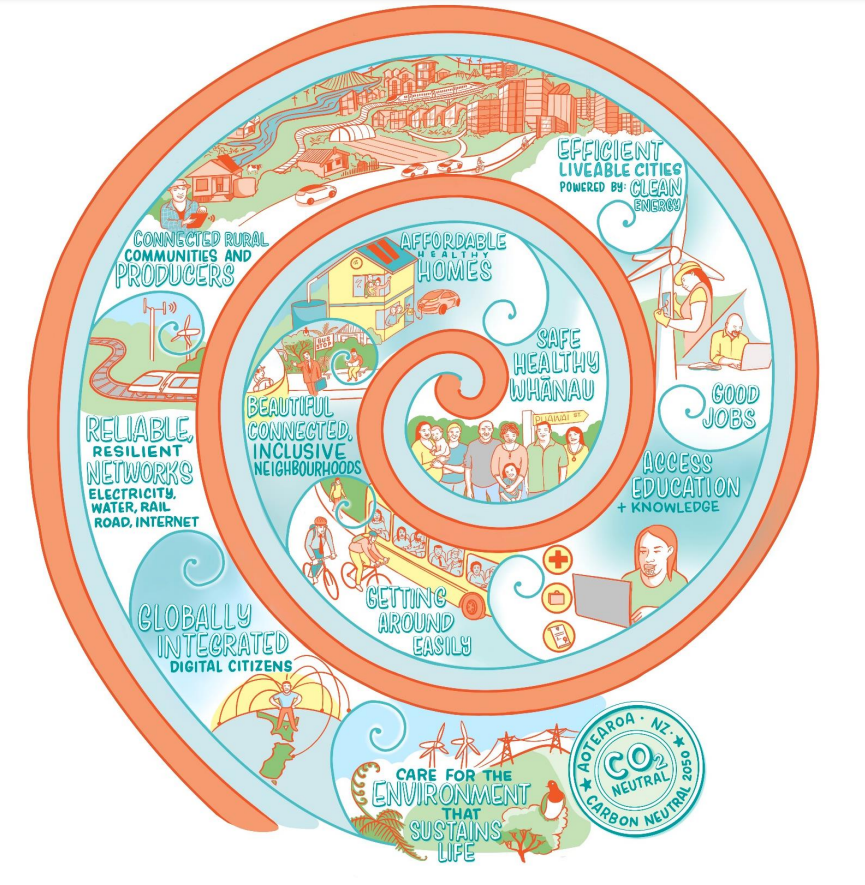
    The New Zealand draft infrastructure strategy clearly links infrastructure with well-being

    But the WIIS goes a bit further; there is a very tight integration between the well-being goals, the nature and climate emergencies, and infrastructure, throughout the document. It appears to explicitly set out to break down the walls between ‘hard’ and ‘soft’ infrastructure, demonstrating that social and natural infrastructure are of equal importance to what might be perceived as ‘traditional’ forms of infrastructure such as roads or buildings.

    This aligns with my personal ‘philosophy’ of infrastructure that prioritises happiness, health and long-term sustainability over more straightforward but less helpful indicators such as GDP. This is not to say that economic indicators are irrelevant; but to accept that the playing field has been highly skewed towards increasing outputs that are tangential to well-being, at least once a certain amount of wealth has been achieved at a country-level. 

    In order to redress the balance – as required by our understanding of the near-unbearable pressures that our activities are causing to local and global ecosystems – we must therefore radically amend every policy, budgetary and social tool at our disposal. 

    Readers of the WIIS will probably be pleased to see frequent mentions to the transport hierarchy and to Llwybr Newydd (the Wales Transport Strategy). The circular economy is also a significant beneficiary of focus, with support earmarked for repair and reuse-type projects. 

    Other sectors receiving considerable attention are housing (particularly with regard to decarbonisation efforts), biodiversity and natural capital, and the revitalisation of town centres.

    In the foreword to the WIIS, Rebecca Evans AS says:

    “Instead of thinking first “what infrastructure should we invest in?” the question must be “what should investment in our infrastructure enable?”.

    It’s exactly the right way to structure the discussion. Wales’ infrastructure needs to enable, empower, support and safeguard. In a complex world, replete with wicked problems, we need to create a framework that provides us with the principles and guidance to deliver long-term improvements across every facet of society. 

    The Well-being of Future Generations Act is that framework; and this Infrastructure Strategy is a worthy complement to it.

    ———————————————————————————

    Some key Welsh policies referred to within WIIS:

  • Introducing Nikira

    This guest post is by Nikira Bowen, Graduate Intern. We gratefully acknowledge the support provided by Welsh Government and Swansea University in enabling this placement.

    Hello, my name is Nikira and I’m the newest member of the team at Afallen. I’m originally from Mumbles on the Gower Peninsula. Growing up, I spent most of my time outdoors – usually at the beach – and since then not much has changed. My hobbies include reading, sea-swimming, and baking, and I love spending time with my friends and family.

    I hold a BSc in Physical Earth Science from Swansea University, graduating in 2019. This had a strong focus on geology, palaeontology, climate change, ecosystems, and natural hazards. My undergraduate dissertation involved using satellite imagery to predict volcanic eruptions, using Wolf Volcano in the Galapagos as an example. It was during my undergraduate degree that I became passionate about climate change, and the decision to study for a master’s degree in Environmental Dynamics and Climate Change was an easy one. It involved studying the science behind climate change, climate policies across the globe, and the environmental consequences of climate change such as wildfires and sea level rise. My studies have taken me far and wide, from geological mapping on the Isle of Aran in Scotland to studying karst landscapes and plant adaptations in Mallorca, and studying landslides and biodiversity in Sikkim in the Indian Himalayas.

    Facts about me:

    • I single-handedly built the empire state building*
    • I drink a LOT of tea (exclusively earl grey)
    • I’m a big fan of RuPaul’s Drag Race
    • I’m excited to be part of Afallen!

    *out of Lego, not to scale.

  • Cyflwyno Nikira

    Mae’r post westai hon gan Nikira Bowen, Intern Graddedig. Rydym yn ddiolchgar i gydnabod y gefnogaeth a roddwyd gan Lywodraeth Cymru a Phrifysgol Abertawe i alluogi’r lleoliad hwn.

    Helo, fy enw i yw Nikira a fi yw’r aelod mwyaf newydd o’r tîm yn Afallen. Rwy’n wreiddiol o’r Mwmbwls ar Benrhyn Gŵyr. Wrth dyfu i fyny, treuliais y rhan fwyaf o fy amser yn yr awyr agored – ar y traeth fel arfer – ac ers hynny does dim llawer wedi newid. Mae fy hobïau yn cynnwys darllen, nofio ar y môr, a phobi, ac rydw i wrth fy modd yn treulio amser gyda fy ffrindiau a fy nheulu.

    Mae gen i BSc mewn Gwyddor Daear Ffisegol o Brifysgol Abertawe, gan raddio yn 2019. Roedd gan hyn ffocws cryf ar ddaeareg, palaeontoleg, newid yn yr hinsawdd, ecosystemau, a pheryglon naturiol. Roedd fy nhraethawd israddedig yn cynnwys defnyddio delweddau lloeren i ragfynegi ffrwydradau folcanig, gan ddefnyddio Wolf Volcano yn y Galapagos fel enghraifft. Yn ystod fy ngradd israddedig y deuthum yn angerddol am newid yn yr hinsawdd, ac roedd y penderfyniad i astudio ar gyfer gradd meistr mewn Dynameg Amgylcheddol a Newid Hinsawdd yn un hawdd. Roedd yn cynnwys astudio’r wyddoniaeth y tu ôl i newid yn yr hinsawdd, polisïau hinsawdd ledled y byd, a chanlyniadau amgylcheddol newid yn yr hinsawdd fel tanau gwyllt a chodiad yn lefel y môr. Mae fy astudiaethau wedi mynd â mi ymhell ac agos, o fapio daearegol ar Ynys Aran yn yr Alban i astudio tirweddau carst ac addasiadau planhigion ym Mallorca, ac astudio tirlithriadau a bioamrywiaeth yn Sikkim yn yr Himalaya Indiaidd.

    Ffeithiau amdanaf i:

    • Fe wnes i adeiladu adeilad y wladwriaeth ymerodraeth ar ei ben ei hun *
    • Rwy’n yfed LLAWER o de (llwyd iarll yn unig)
    • Rwy’n gefnogwr mawr o RuPaul’s Drag Race
    • Rwy’n gyffrous i fod yn rhan o Afallen!

    *allan o Lego, nid i raddfa.

  • What the Romans can teach us about the value of the Welsh language

    What the Romans can teach us about the value of the Welsh language

    Rome from the river

    What the Romans can teach us about the value of the Welsh language

    The Roman Empire was pre-eminent in terms of trade, agriculture and international networks of information and trust.

    Not until industrial times did the earth see a city as large as Rome, and as needing such huge quantities of food – and wine. How was it that the Roman empire was able to sustain a population of 1 million people in a city – a population that required nearly 250,000 tonnes of grain annually? And how could it sustain itself at that population for half a millennium?

    In principle, transactional costs at each step of the way, say from the food producing regions of the Nile, through to the trading houses at Alexandria, and on to Rome, should have crippled this market, and Rome should never have become a pre-industrial metropolis.

    And yet, in the face of informational uncertainty, and these transactional costs, the city survived – and indeed thrived – for hundreds of years. Not until the London of the 19th Century did a city become bigger.

    It was estimated that the additional cost premium of moving grain from Spain to Rome, rather than from obtaining it close to Rome itself, was just 16%, which was a pretty remarkable achievement for the time.

    Part of the reason for this success was the ability of the Roman state to eliminate transaction costs at certain parts of the supply chain, through (effectively) a salary, or the promise of gifts due to services rendered.

    The benefit of transactional cost efficiency, however, comes at the price of moral hazard – in other words, a misalignment between the interests of the people who want the profits, and those who generate the profits. For example, people making bread in Rome had to pay for future deliveries of grain at an acceptable price, and they had to do that at risk – for what was to stop the farmer at the far end of the supply chain from reneging on their part of the agreement? One must have considerable confidence in the likelihood of generating a return on capital before it is going to be put to work in a far-off land.

    The Romans solved this problem partly because they had an efficient and functioning legal system which could be used to verify the contracts. However a strong legal system – on its own – is insufficient for constraining agency costs. This formal legal system was underpinned by an informal ‘moral contract’ of behaviour which was embedded in the relationships between slave owners and freed men who mutually gained from the reputation of the other. 

    Trust and reputation therefore acted as a way of constraining systemic agency costs in Roman times, just as it still does today – although it is transferred and imbued in very different ways.

    The Welsh language

    The Welsh-speaking community is relatively small within the UK context, and extremely so within the international context. This means that the ‘six degrees of separation’ concept – the idea that any two people on the planet are, on average, six or fewer social connections from one another, shrinks to maybe two or three degrees of separation within the context of Welsh-speakers.

    This creates a relatively higher level of social risk associated with acting in bad faith, or fraudulently, within the context of the Welsh language, than in the English language. 

    In the same way as a trader within a small village lives – or not – by the quality of their service and their reputation – traders who embrace the Welsh language are making a commitment to the quality of their product or service within the ‘village’ of the Welsh language.

    This reputational alignment brings benefits to organisations both small and large. Small companies benefit from provision of Welsh language services by demonstrating their understanding of, and commitment to, language issues, which could arguably be seen as a proxy for their commitment to Wales as a national entity. Large organisations who offer services in Welsh – whether based in Wales or not – benefit from the perception that they have invested sufficiently within the language to understand the value of it to the people of Wales, and further that they value it sufficiently to employ people to be able to deliver their services through the medium of Welsh.

    In other words, using Welsh in the world of commerce reduces the risk to the purchaser that the supplier will provide sub-par products or services.

    There’s another benefit – to the ‘resilience and prosperity’ parts of Wales – related to organisations domiciled in Wales, and paying local and national taxes, because companies trading through the medium of Welsh are overwhelmingly likely to be domiciled within Wales, and furthermore to be of insufficient scale to avoid paying their taxes here.

    So by using Welsh as a preferred language of commerce – for those of us privileged to be able to do so – we are both reducing our risk as users of products or services, and increasing the likelihood that the profits retained from our purchase of said services will be taxed within Wales. For those of us who aren’t able or confident enough to use our Welsh, we can still benefit from the increased levels of trust in those companies that are providing their services through the medium of Welsh.

    Do I personally buy all my products or services from companies with a Welsh-language service? No, and partly because that information isn’t readily available. Whilst the likes of Ffônlyfr from Menter Caerdydd are helpful local tools, what Wales needs is a location-based map, response for mobile devices, where you can search for your nearest cafe, pub, hairdresser or professional service that can deliver that service through Cymraeg. This is my challenge to Wales’ vibrant developer community! And I think that there’s a sound business model for such a product. For example, my own company, Afallen, would happily pay a monthly subscription for inclusion in such a directory.

    I believe that the growing confidence and numbers of Welsh speakers will have a small but positive impact on our society and economy, and particularly for those organisations who can offer all their services through the medium of Welsh. Now – where’s that app for Welsh language businesses…I fancy a take-out coffee.