I was recently made aware of a superb book on organisational structure and management called ‘reinventing organisations’.
It’s an unusual book; firstly, you don’t have to pay anything up front. The author requests that you pay him what you think it’s worth, and only after you’ve had a chance to read and digest the contents.
Secondly for a book focusing on how organisations are managed, it’s incredibly readable. Yes, you read that right. It’s a book about how to manage your organisation in a different way, and it’s un-put-downable (particularly the illustrated version!)
For those of us who are juggling many important tasks related to work, family and schooling that’s important – we often don’t have the luxury of extended periods of time to dive into more ‘weighty’ tomes.
But I don’t want to do this book an injustice by implying that it is in some way not serious or worthy by virtue of it being readable in one evening (if my experience is in any way indicative).
It’s a revolutionary piece of work which upends the ‘traditional’ model of management, and which resonates instinctively with my own values and ways of working. In fact, I was so excited while reading it that I was sending messages with great frequency to my colleague, highlighting similarities or differences with the way that we work at Afallen.
I won’t spoil the surprise and excitement for you – if you have the niggling feeling that the organisation you work for does not exist to have you reach your full human potential, then you will be thrilled to learn that organisations exist which have exactly that priority.
In that sense, Afallen is already on the journey to becoming one of these reinvented organisations – called ‘teal’ organisations in the book.
Some of the characteristics of these ‘teal’ organisations are of a flat management structure, with devolved decision-making and high levels of internal transparency.
Given that the founding Partners of Afallen knew each other, shared a set of values and came with similar levels of professional experience, it’s perhaps not a surprise that we’ve set off in the right direction. Our challenge will inevitably come when we grow and are challenged by new Partners to maintain our openness and freedom of operation
I am delighted that there are many excellent resources available for organisations wanting to revolutionise the way that they carry out their functions – Valve’s employee handbook hits all the right notes in this regard – which will simplify the process if we decide to go ahead and ‘Afallen-ify’ the many variations of the different ‘teal’ organisations.
And I’m really pleased that we subconsciously designed Afallen along lines which are broadly compatible with a ‘teal’ organisation. In fact, if we decide to go down this path, we won’t really have to reinvent Afallen at all. We’ve just been made aware that there are many pathways for us to consider, and many people that we can turn to for advice and support as and when we need it.
I’m excited at the prospect of making this journey, and I believe that it’s entirely aligned with Afallen’s values and mission. I believe that it will make us a more effective collaborator, a more responsive organisation and therefore better able to fulfill our mission of supporting the practical implementation of the Well-being of Future Generations, in Wales and beyond.
Cefais fy hysbysu yn ddiweddar o lyfr gwych ar strwythur a rheolaeth sefydliadol o’r enw ‘ailddyfeisio sefydliadau’.
Mae’n llyfr anghyffredin; yn gyntaf, does dim rhaid i chi dalu unrhyw beth ymlaen llaw. Mae’r awdur yn gofyn i chi dalu’r hyn rydych chi’n meddwl ei fod yn werth, a dim ond ar ôl i chi gael cyfle i ddarllen a threulio’r cynnwys.
Yn ail ar gyfer llyfr sy’n canolbwyntio ar sut mae sefydliadau’n cael eu rheoli, mae’n hynod ddarllenadwy. Ie, rydych chi’n darllen hynny’n iawn. Mae’n llyfr am sut i reoli’ch sefydliad mewn ffordd wahanol, ac mae’n ddigymar (yn enwedig y fersiwn ddarluniadol!)
I’r rhai ohonom sy’n jyglo llawer o dasgau pwysig sy’n gysylltiedig â gwaith, teulu ac ysgol, mae hynny’n bwysig – yn aml nid oes gennym y moethusrwydd o gyfnodau estynedig o amser i blymio i feddau mwy ‘pwysfawr’.
Ond dwi ddim eisiau gwneud y llyfr hwn yn anghyfiawnder trwy awgrymu nad yw mewn rhyw ffordd yn ddifrifol nac yn deilwng yn rhinwedd ei fod yn ddarllenadwy mewn un noson (os yw fy mhrofiad yn arwyddol mewn unrhyw ffordd).
Mae’n ddarn chwyldroadol o waith sy’n defnyddio’r model rheoli ‘traddodiadol’, ac sy’n atseinio’n reddfol gyda fy ngwerthoedd a ffyrdd fy hun o weithio. Mewn gwirionedd, roeddwn i mor gyffrous wrth ei ddarllen fy mod i’n anfon negeseuon yn amlach iawn i’m cydweithiwr, gan dynnu sylw at debygrwydd neu wahaniaethau gyda’r ffordd rydyn ni’n gweithio yn Afallen.
Wna i ddim difetha’r syndod a’r cyffro i chi – os oes gennych chi’r teimlad bach nad yw’r sefydliad rydych chi’n gweithio iddo yn bodoli er mwyn i chi gyrraedd eich potensial dynol llawn, yna byddwch chi wrth eich bodd o glywed bod sefydliadau’n bodoli sydd â’r union beth hwnnw blaenoriaeth.
Yn yr ystyr hwnnw, mae Afallen eisoes ar y daith i ddod yn un o’r sefydliadau hyn sydd wedi’u hailddyfeisio – o’r enw sefydliadau ‘teal’ yn y llyfr.
Mae rhai o nodweddion y sefydliadau ‘teal’ hyn o strwythur rheoli gwastad, gyda phenderfyniadau datganoledig a lefelau uchel o dryloywder mewnol.
O ystyried bod Partneriaid sefydlu Afallen yn adnabod ei gilydd, wedi rhannu set o werthoedd ac wedi dod â lefelau tebyg o brofiad proffesiynol, efallai nad yw’n syndod ein bod ni wedi cychwyn i’r cyfeiriad cywir. Mae’n anochel y daw ein her pan fyddwn yn tyfu ac yn cael ein herio gan Bartneriaid newydd i gynnal ein didwylledd a’n rhyddid i weithredu
Rwy’n falch iawn bod llawer o adnoddau rhagorol ar gael i sefydliadau sydd am chwyldroi’r ffordd y maent yn cyflawni eu swyddogaethau – mae llawlyfr gweithwyr Valve yn taro’r holl nodiadau cywir yn hyn o beth – a fydd yn symleiddio’r broses os penderfynwn fwrw ymlaen ac ‘Afallen -ify ‘yr amrywiadau niferus o’r gwahanol sefydliadau’ corhwyaid ‘.
Ac rwy’n falch iawn ein bod wedi cynllunio Afallen yn isymwybod ar hyd llinellau sy’n gydnaws yn fras â sefydliad ‘teal’. Mewn gwirionedd, os penderfynwn fynd ar hyd y llwybr hwn, does dim rhaid i ni ailddyfeisio Afallen o gwbl. Rydyn ni newydd gael ein gwneud yn ymwybodol bod yna lawer o lwybrau i ni eu hystyried, a llawer o bobl y gallwn droi atynt am gyngor a chefnogaeth yn ôl yr angen.
Rwy’n gyffrous gyda’r gobaith o wneud y siwrnai hon, a chredaf ei bod yn cyd-fynd yn llwyr â gwerthoedd a chenhadaeth Afallen. Credaf y bydd yn ein gwneud yn gydweithredwr mwy effeithiol, yn sefydliad mwy ymatebol ac felly’n gallu cyflawni ein cenhadaeth yn well i gefnogi gweithredu Llesiant Cenedlaethau’r Dyfodol yn ymarferol, yng Nghymru a thu hwnt.
I’m really encouraged by this approach to a new #digitalstrategy for Wales – and for public services in particular.
I like the way that a blog is being used to describe each of the ‘missions’ which underpin the strategy, and I think that there are many positive aspects (and potential outcomes) from the missions.
But….so far, there’s been a notable omission from any of the narrative for me – and that’s any explicit mention of #opensource.
Open source software (yes, and even hardware in some cases), underpins most of the world’s IT infrastructure and systems. It liberates, educates, and is a tool to lower barriers and costs for billions of existing and potential digital users globally.
In the context of Wales’ Future Generations legislation, it’s a slam-dunk for many of the goals, and more so in many cases than closed-source tools.
At the outset of a digital strategy development cycle, we have the incredible opportunity to embed a philosophical and practical commitment to using, supporting, developing and championing open source technologies. With the devolution of education, we also have the opportunity of developing this theme through formal education in schools, colleges and universities; and through informal routes such as Code Clubs.
I’ve previously written about the dangers to democracy from untrammelled use of ‘corporate surveillance’ platforms. The other side of that coin is the growth of the open source social media world – the ‘Fediverse’ – which points to a more responsible, respectful and kinder online world.
It’s not beyond imagination that Wales becomes a standard-bearer for open source solutions, playing a significant role in global contributions to software and hardware. The outcomes for us – and for the world – could be huge. Look what happened when Estonia developed a strong Governmental interest in digital and cybersecurity!
I look forward to seeing future blog posts from Welsh Government, and I hope that open source starts becoming a more visible component of future updates!
Fe wnaethon ni sefydlu Afallen ym mis Hydref 2018 wedi’i seilio ar set o werthoedd.
Roeddem am i Afallen fod yn ymgorfforiad o’n hymrwymiadau personol i weld Cymru yn cyflawni ei photensial fel gwlad gynaliadwy, gan ddangos ffyrdd ymarferol o wella’r ffordd yr ydym yn byw, mewn ffordd sy’n cyfoethogi pob dinesydd ac yn cefnogi ein hecosystemau.
Un o’r ymrwymiadau pwysicaf a wnawn yw cadw mwy o arian, a phobl â thalent, yng Nghymru. Mae symiau enfawr o arian – cyhoeddus a phreifat – yn gadael Cymru bob dydd, ynghyd â llawer o’n gorau a’r mwyaf disglair wrth geisio rhagolygon swyddi mewn mannau eraill. Yn ein ffordd gymedrol ein hunain, ein nod yw cadw mwy o’r arian a’r cyfle hwnnw yng Nghymru; ac nid yng Nghymru yn unig, ond i’w rhawio mor gandryll â phosib allan o Gaerdydd ac i bob cornel o’r wlad.
Nodir ein hymrwymiad i ddull Cenedlaethau’r Dyfodol ar dudalen gartref y wefan
Rydym yn adeiladu ein rhwydwaith o sefydliadau partner, unig fasnachwyr ac ymgynghorwyr; o Ynys Môn i Ynysybwl ac ym mhobman yn y canol, credwn fod pobl yn gweithio orau lle maent yn gadarn ac yn hapus. Rydyn ni am i bobl allu cyflawni pethau gwych yn y lleoedd lle maen nhw wedi gwneud eu bywydau. (Gyda llaw – os ydych chi’n unig fasnachwr, neu’n fusnes bach, yn canolbwyntio ar ddarparu rhagoriaeth yn eich maes – cysylltwch â ni!)
Mae hefyd yn bwysig i ni ddangos ein bod nid yn unig yn dweud y pethau hyn, ein bod yn eu gwneud. Dyna pam rydyn ni wrth ein bodd yn adrodd bod bron i 97% o’n gwariant gyda phobl a sefydliadau yng Nghymru am y flwyddyn ddiwethaf. Roedd y 3% arall ar gyfer rhai gwasanaethau TG ac yswiriant.
Pan fyddwch yn comisiynu Afallen i weithio i chi, gwyddoch y byddwn yn gwneud ein gorau glas i gefnogi cadwyni cyflenwi lleol. Byddwn yn ymdrechu i ddarparu gwaith ystyrlon i fusnesau bach ac unigolion ledled Cymru. Wrth wneud hynny, byddwn yn helpu i gadw arian i lifo yn siopau, tafarndai a swyddfeydd post y pentref sydd mor hanfodol wrth gynnal llesiant a gwytnwch cymunedol.
Yn wir, gellid darllen bod llawer o’r Nodau Llesiant yn ddim llai na gofyniad i ganolbwyntio ar gadw arian a thalent yng Nghymru trwy gefnogi busnesau lleol.
Cymru gwydn? Trwy ledaenu ein gwariant o amgylch busnesau bach rydym yn helpu i adeiladu lluosogrwydd o ddewis i eraill sy’n arallgyfeirio’r sylfaen dreth. Rydym hefyd yn gallu dylanwadu ar eraill i ddod yn fwy gwydn yn yr hinsawdd yn y ffordd maen nhw’n cyflawni eu gwaith
Cymru o gymunedau cydlynol? Gyda mwy o arian yn cylchredeg yn y trefi a’r pentrefi bach, mae gennym gyfle i helpu i ddiogelu adnoddau dinesig hanfodol.
Cymru lewyrchus? Trwy gadw talent ac arian yng Nghymru, rydym yn helpu i ddiogelu swyddi, addysg a chyfleoedd gwaith i bobl ifanc yfory.
Cymru o Ddiwylliant Bywiog ac Iaith Gymraeg Ffynnu? Mae ein hymrwymiad i ddarparu ein holl wasanaethau trwy gyfrwng Cymraeg (gan gynnwys y blogbost hwn!) Yn gwarantu ein bod yn chwarae ein rhan i alluogi’r Gymraeg i ddod yn iaith naturiol busnes a chymuned.
Mae’r adroddiad hwn ar ein gwariant dros y deuddeg mis diwethaf yn bleser ei gyhoeddi. Ein haddewid yw parhau i ymdrechu tuag at y nod o 100%, a helpu i adeiladu Cymru sy’n cyflawni ei haddewid i Genedlaethau’r Dyfodol.
We founded Afallen in October 2018 on a set of values.
We wanted Afallen to be the embodiment of our personal commitments to seeing Wales fulfill its potential as a sustainable country, demonstrating practical ways to improve the way we live, in a way which enriches every citizen and supports our ecosystems.
One of the most important commitments we make is to keep more money, and people with talent, in Wales. Huge amounts of money – public and private – leaves Wales every day, along with many of our best and brightest in pursuit of job prospects elsewhere. In our own modest way, we aim to keep more of that money and opportunity in Wales; and not just in Wales, but to shovel it as furiously as possible out of Cardiff and into every corner of the country.
Our commitment to the Future Generations approach is stated on the home page of the website
We are building our network of partner organisations, sole traders and consultants; from Ynys Môn to Ynysybwl and everywhere in between, we believe that people work best where they are grounded and happy. We want people to be able to achieve great things in the places where they have made their lives. (By the way – if you’re a sole trader, or a small business, focused on delivering excellence in your field – please get in touch!)
It’s also important to us to demonstrate that we not only say these things, we do them. That’s why we’re delighted to report that for the last year, nearly 97% of our spend was with people and organisations based in Wales. The remaining 3% was for some IT services and insurance.
When you commission Afallen to work for you, you know that we will do our utmost to support local supply chains. We will endeavour to provide meaningful work for small businesses and individuals right across Wales. In so doing, we will help keep money flowing in the village shops, pubs and post offices which are so vital in maintaining community well-being and resilience.
Indeed, many of the Well-being Goals could be read as no less than a requirement to focus on retaining money and talent in Wales through supporting local businesses.
A resilient Wales? By spreading our spend around small businesses we help build a plurality of choice for others which diversifies the tax base. We’re also able to influence others to become more climate-resilient in the way they carry out their work
A Wales of cohesive communities? With more money circulating in the small towns and villages, we have the opportunity to help safeguard essential civic resources.
A prosperous Wales? By keeping talent and money in Wales, we are helping to safeguard jobs, education and work opportunities for the young people of tomorrow.
A Wales of Vibrant Culture and Thriving Welsh Language? Our commitment to providing all our services through the medium of Welsh (including this blog post!) guarantees that we are playing our part in enabling Welsh to become a natural language of business and community
This report on our spend over the last twelve months is a pleasure to publish. Our promise is to continue striving towards the goal of 100%, and to help build a Wales that fulfils its promise to Future Generations.
As someone with a strong interest in politics and public affairs, I’ve been following the IndyWales discussion with interest for many years.
Nothing has the potential to change the nature of our politics, constitution, society and environment as much as becoming an independent nation, and whilst these discussions have taken place as long as my political awareness has been in existence, they have hitherto not been part of mainstream public discourse.
The meteoric rise of YesCymru membership which now numbers more than 13,000 (from just over 2,000 at the start of 2020) has changed the framework of public debate in Wales. According to some sources, paid-up members now number more than any political party in Wales except for Labour.
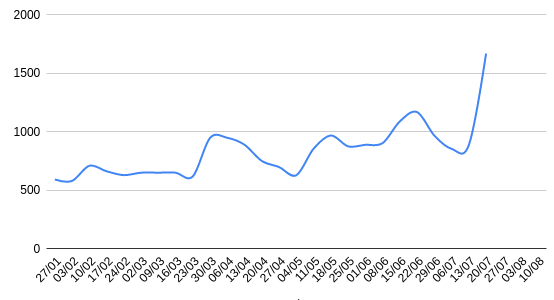
I decided to take a look at mentions of YesCymru on Twitter, from the very first days (August 2014) until now. I was curious about what was driving the discussion. Taking mentions of YesCymru as a proxy for interest in the organisation as a whole (and therefore IndyWales more generally) and I wanted to test the theory that pronouncements made in Westminster have an impact on YesCymru interest.
The early years
The first graph shows the frequency of mention of YesCymru over the whole span, from August 2014 until the present day.
By recent standards, there was very little activity over those early years; the activity tended to be catalysed by events within Wales itself, such as marches for independence.
However more recently there are clearly defined peaks in activity which correlate more strongly with specific events in Westminster. For example, there was a flurry of activity on the day following the General Election in 2019 in which the Conservatives were returned with a significantly increased majority.
As with many social media movements or campaigns, there was not much in the early years to report on.
Typically, early activity from any social media account consists of regular engagement to build up ‘brand’ awareness and forge relationships.
The science of social media demonstrates empirically that large social media accounts grow more quickly and have far greater interaction, so even in the absence of external factors, there would have been an increasing trend of mentions of YesCymru over time.
However, what we can see from the data is that external factors are playing a huge role in engagement, and that the factors which appear to be playing the biggest role are indeed those performed by UK Government – as highlighted by Plaid Cymru’s Liz Saville Roberts.
I find it particularly interesting that even where decisions are taken in Westminster that do not directly affect the people of Wales – the decision not to provide free school meals to the poorest children in England as a prime example – this still results in a huge amount of increased discussion around IndyWales.
This appears to suggest that the institutions of Westminster are becoming increasingly scrutinised by the people of Wales for unfairness, not just to Wales, but to citizens in other parts of the UK.
It’s still very early days for discussions about independence in Wales, but it’s certain that analysing Twitter will continue to provide a rich seam of data for researchers examining politics and society here.
“our data are our stories. When our data are manipulated, distorted, stolen, exploited, or misused, our communities are stifled, obstructed, or repressed, and our ability to self-determine and prosper is systematically controlled” (1)
The UK story
The story of the 2010s can – to a significant extent – be told by the exploitation of private data, unwittingly harvested from individuals, to allow falsehoods to be directly targeted at those most susceptible.
From the perspective of the citizens of Wales, the biggest systemic impact of the decade was Brexit. It will likely be the biggest impact, potentially eclipsing even the extraordinary social impact of coronavirus, for decades to come.
One of a series of adverts displaying a false dilemma during the campaign on voting to change the electoral system for elections to the UK Parliament.
Although the deliberate false dilemma (2) has been used numerous times in election campaigns prior to the Brexit vote (notably by those responsible for running the Vote Leave campaign), it was hitherto not possible to target such advertising to the individual. It generally appeared in the traditional press, on billboards and in other public places.
Techniques became available through the 2010s which allowed advertising to be targeted to an astonishing level of detail; never before was so much falsehood directed with such accuracy. Animal-lovers were targeted with images of bullfighting and encouraged to sign up to the vote leave campaign. People hostile to immigration were targeted with (false) images of Turkey joining the EU. The EU was even falsely accused of wanting to ‘kill our cuppa’ – whatever that means.
A false dilemma advert for the Brexit campaign, presumably targeted geographically or by origin of the individual viewing it. Note the £350 million figure again, presumably ‘spent’ in hundreds of different ways during the campaign depending on the advert recipient.
In presenting issues of extraordinary complexity, in such a simplistic, binary and dishonest way, the leave campaign was able to provide strong messaging in a way that caused people to act; to sign up, to part with their personal data, and often to become activists. This messaging contrasted with a more nuanced, and highly flawed, attempt to persuade people that their interests were better served by remaining in the EU – something that will almost certainly be borne out by the reality of the consequences of the vote to leave.
One of the most astonishingly brazen acts of data collection was with the launch of a £50m competition – statistically almost impossible to win – which was free to enter, and which was promoted by household names, including Ian Botham (3).
Ian Botham was happy to become the face of the project to harvest – effectively for free – the contact details of hundreds of thousands of competition participants
In order to qualify for the competition, the user had to submit personal information, including contact details. It was the perfect, albeit ethically dubious, way for a campaign to move from a database of zero to potentially hundreds of thousands within a very short timeframe.
While we have yet to know in what way the impacts of Brexit will play out for our families and communities, we do know that the methods of campaigning deployed with such devastating impact during the Brexit referendum are likely to be refined and re-deployed in future elections and referendum campaigns.
So what does that mean for us here in Wales?
The threat to Wales
At the moment any existential threat to Wales’ democracy seems fanciful. The increasing powers of the Senedd (4) have been endorsed in consecutive referenda. Public levels of confidence in our legislative body are extremely high compared with attitudes towards Westminster (5), an attitude which has been bolstered by a visible difference in how the rules governing behaviour during the coronavirus outbreak were implemented in Wales compared to England.
However, those of us who are strong supporters of a powerful and independent Senedd would do well to consider what could happen if and when the attention of the masters of manipulation social media turn their attention to elections in Wales. Should they wish to create or support a campaign to dismantle the Senedd, can any of us assert with confidence that our institutions are invulnerable? Could a package of misinformation, targeted to trigger the innermost hopes or fears of millions of users of social media in Wales, result in the activating of large swathes of our hitherto non-voting population agreeing with messages such as:
“Better funding Welsh schools or an expensive talking shop (referring to the Senedd)”
“More nurses in Wales’ hospitals or an expensive talking shop”
“A strong Welsh culture and language or an expensive talking shop”
“A new transport system or an expensive talking shop”
(It will be interesting to see how the Conservative party’s Welsh branch, supported with digital marketing expertise from party headquarters performs in the 2021 Senedd elections. My hunch is that they will considerably overperform against current polling, and that the change will happen in the month or two prior to the vote, concomitant with a digital campaign.)
Unfortunately the threat to a well-financed digital media campaign informed by huge troves of data obtained from the citizens of Wales is not easy to mitigate. The Electoral Commission has shown itself to be toothless in the face of law-breaking with regard to referendums and elections (6). Fines of tens of thousands of pounds are meaningless in the context of shifts of power between political parties, or on matters of great constitutional significance. With the UK Government profoundly unconcerned by reports of Russian interference in the last General Election (7), we now hear that the Electoral Commission itself is on the list of organisations threatened with extinction (8).
What of digital protection? Outside the EU we are no longer covered by the GDPR. Whilst the UK is almost certain to legislate in some form to protect the interests of the individual, I believe it unlikely that the Government will strengthen protection for our citizens over and above the privileges that we enjoyed as EU citizens.
In other words, the conditions are potentially ripe for individuals or organisations wishing to turn back the devolutionary clock in Wales.
The solution?
A threat this complex, well-resourced and intangible is not easy to manage. With little prospect of protection for our elections – and the way that campaigns are managed – from a UK Government which is demonstrably dismissive of devolved institutions (9), the answer will lie within Wales itself, and will require a strategic and long-term approach, coincidentally the approach mandated by the Act for the Well-being of Future Generations.
Very briefly, some elements of defence against the current social media dominance would include
Education; this needs to start early – ideally before children have become comfortable with the idea of ‘sharing’ their personal data without an understanding of the value of that data, and of the potential consequences from so doing. However the education needs to go for beyond schools, and into civil society. Agents of education will be needed in many different spheres of public life.
Promotion of platforms which provide similar functionality but which respect privacy and data, and do not allow advertising or the sale of user data. There is an ethical, open source alternative to many existing social media platforms, and good resources describing how to subscribe to them (such as switching.software)
The adoption of ethical alternative platforms by the institutions of Welsh Government and governance, in order to demonstrate their understanding of the issues surrounding existing structures, and to visibly support the fledgling open source platforms with the gravitas of their institutions
Unless the users of corporate social media platforms vote with their feet and start really ‘taking back control’, we will end up feeding the digital corporations with the revenue and data which enables them to exert almost unrestricted power and influence over our democratic processes.
And, ultimately, over our democratic institutions themselves.
Some first practical steps
The process of moving towards a privacy and democracy-respecting digital workflow does not have to be overly complicated. It can start with steps as simple as the following:
David Clubb, a Partner at Afallen, is a moderator on the toot.wales instance of Mastodon (an open source version of Twitter), and is able to provide training and support for organisations starting on their journey to a more sustainable and democracy-supporting use of digital technology and social media.
Great article, sharing it far and wide. @SusWales is looking to make switches to ethical, alternative platforms based on your piece and link to switching.software 👍
@davidoclubb@jaz @NationCymru@twitter.activitypub.actor very good piece David, accurate and sensible. I’ve been following, advocating and helping mitigate in these areas for a while, but increasingly feel pessimistic as we’re losing fast on so many fronts. I’m still regularly shocked at what the privacy researchers I follow discover. twitter.com/WolfieChristl is exceptionally good.I still put many hours a week into Safe though, it has a lot of potential and will make all the mitigations you advocate easier to realise.
Mae Asiantaeth yr Amgylchedd Ewropeaidd wedi diweddaru ei data ar nifer y cerbydau trydan newydd a brynwyd yn Ewrop. Pan gaiff ei ddadansoddi fel cyfran o gyfanswm y ceir, Norwy yw’r arweinydd y tu allan ac allan.
Mae’r DU yn chwaraewr canol y tabl, ond mae hyn yn cuddio amrywiadau mawr iawn yn ôl gwlad. Mae Gogledd Iwerddon a Chymru ill dau yn cael eu gwasanaethu’n wael gan seilwaith gwefr gyflym, sy’n effeithio’n sylweddol ar ddefnydd lleol, a thueddiad defnyddwyr cerbydau trydan i dreulio amser (yn enwedig ar wyliau) yn y gwledydd hynny.
Mae Llywodraeth Cymru wedi cydnabod hyn fel mater, ac wedi addo cyllid i wella’r ddarpariaeth ar gyfer codi tâl cyflym (ac eraill) yng Nghymru.
The European Environment Agency has updated its data on the number of new electric vehicles purchased in Europe. When analysed as a proportion of the total cars, Norway is the out-and-out leader.
The UK is a mid-table player, but this disguises very large variations by country. Northern Ireland and Wales are both poorly served by rapid-charge infrastructure, which impacts significantly on both local use, and the inclination of electric vehicle users to spend time (particularly on holiday) in those countries.
Welsh Government has recognised this as an issue, and has pledged funding to improve the provision of rapid (and other) charging in Wales.
This guest blog post was written by our Partner, David Clubb. Afallen is proud to support, champion and use open source social media networks including Pixelfed and Mastodon. We’re happy to work with organisations to help you understand, and incorporate, open source social media into your digital strategy and workflow.
Facebook allows lies to spread virtually unchecked. It permits those people with the most money and least scruples to disseminate falsehoods to those most susceptible. And it allows this with no prospect of holding individuals or organisations to account.
Whilst Facebook, Twitter, Instagram and other social media platforms have enabled a blossoming of connection, conversation and shared ideas; they have also created a bitter, divisive, polarised digital world where shareholder value is enhanced most by highlighting division and minimising harmony. Quiet, reasoned thoughts are filtered out by algorithms designed to maximise clicks, retweets and likes. Volume is king.
Many people want to make a difference but they don’t know how. But there is an antidote to the virus of misinformation and hatred. That antidote is open source social media, and it’s already spreading at the fringes of the online universe.
Open source social media
Open source social media doesn’t permit advertising. It doesn’t sell data. It prohibits hate speech and intolerance*. And it’s moderated by users, not resourced at the behest of global tech giants.
More worryingly for the incumbents, the hotbeds of innovation are no longer in the mega-corporations with their teams of thousands in the offices and boardrooms of (mostly) America. They are in the open source equivalents, with code freely available for thousands of supporters and volunteers across the globe to build and improve.
From the perspective of Wales’ Future Generations Act, anybody using, promoting or supporting these open source platforms is supporting the goal of a Globally Responsible Wales. From a worldwide perspective, that same user or supporter is increasing the freely-accessible sum of human knowledge.
One clear example of this innovation is the federation between open source platforms (also known as the Fediverse). Federation is the ability to connect different social media platforms, so that posts and updates become mutually visible.
This means that if you post a photo on Pixelfed (ethical version of Instagram), it pops up in your feed on Mastodon (ethical version of Twitter). Likewise websites, blogs and updates on the ethical equivalent of pretty much every ‘surveillance capitalism’ platform you can think of can cross-post to each other, enabling much more streamlined conversations and updates.
What are the downsides (and upsides)?
Let’s deal with the elephant in the room; the big downside of the new open source Fediverse is that user numbers are far, far lower than for the established platforms.
This is hardly surprising; there’s a headstart of fifteen years or so for many of the tech giants. And the science behind social media means that there’s an agglomeration effect; once most of your friends are engaged on a platform, it takes a significant effort to leave them behind and start something new.
For me personally it meant (mostly) leaving my Twitter account of several thousand followers, and starting a fresh new Mastodon account on toot.wales, one of many ‘locality’ type instances across the world.
I instantly ‘lost out’ on the instantaneous stream of updates from my many friends and colleagues, and on the rough-and-tumble of (what passes for) debate there. There’s likely an impact on my ability to promote my new business, Afallen, through that network, too.
However, what I have found is a new community of online friends and collaborators. I’ve witnessed almost zero hatred or bullying. And I’ve relished using platforms which don’t harvest my personal data in order to sell them to companies who may – in many cases – place profit above the public good.
The truth is that the community of users in Mastodon (and the other platforms) is growing steadily – see the example below for activity on the toot.wales Mastodon instance. At some tipping point – I’m convinced – the growth will start to become exponential, and then the users who became active first will see the biggest benefits.
Weekly interactions on toot.wales, the Welsh instance of Mastodon
But the biggest benefit of all will come when people start to leave the platforms of the tech giants en masse, lessening their influence as the custodians of online debate and information-sharing, and contributing to a kinder, gentler and more thoughtful world of public discourse.
Further information
If you’re interested in finding out more about the ethical, privacy-conscious alternatives to the mainstream social media platforms, head to switching.software.
*Almost all ‘instances’ of open source social media ban hate and intolerance. Those that don’t are generally blocked, so the hatred is restricted to a small portion of the Fediverse



13 responses to “The digital threat to Wales’ democracy”
I commend this article, written by myself.
Slightly abridged for @NationCymru, the full version is available at clubb.cymru/2020/09/04/the…
J
This Article was mentioned on brid-gy.appspot.com
This Article was mentioned on brid-gy.appspot.com
Great article, sharing it far and wide. @SusWales is looking to make switches to ethical, alternative platforms based on your piece and link to switching.software 👍
This Article was mentioned on brid-gy.appspot.com
Good for you guys – very happy to talk through the options and help where I can!
Diolch! Really appreciate it.
@davidoclubb @jaz @NationCymru@twitter.activitypub.actor very good piece David, accurate and sensible. I’ve been following, advocating and helping mitigate in these areas for a while, but increasingly feel pessimistic as we’re losing fast on so many fronts. I’m still regularly shocked at what the privacy researchers I follow discover. twitter.com/WolfieChristl is exceptionally good.I still put many hours a week into Safe though, it has a lot of potential and will make all the mitigations you advocate easier to realise.
This Article was mentioned on brid-gy.appspot.com
This Article was mentioned on brid-gy.appspot.com
This Article was mentioned on brid-gy.appspot.com
This Article was mentioned on brid-gy.appspot.com
[…] The digital threat to Wales’ democracy […]