I first met George when I was a first year undergraduate student at Lancaster University. I attended supervisions with him, in the company of my fellow student Graeme Plenderleith (we are still friends to this day!).
“Someone possessing extraordinary intelligence or skill; especially somebody who has demonstrated this by a creative or original work in science, music, art etc.”
He certainly took no prisoners with his students. I remember the first session we had with him. His room was a chaotic mess of papers and books, and after we’d found ourselves somewhere to sit he asked us questions about the physics we were studying. When I responded to one of his questions with a timid (and wholly inadequate) response, his retort was “like fuck it is”.
I was fairly shocked by that – but George went on to kindly explain to both me and Graeme the basis of our misunderstanding. During the course of that year, he systematically helped break down and rebuild our understanding of the basics of physics, and did so in a way that was somehow warm and patient, even as it was highly intolerant of any lack of intellectual rigour.
When I returned to Lancaster in the 2000’s it was as a post-doc, working in the low-temperature laboratory where George was still very active. It was there that I got interested in his ability to produce incredible graphics to help elucidate the most complex physics properties at low temperatures in ways that were easy to interpret.
My interest in the design side was almost as great as my interest in physics, and when I left the lab to begin a career in renewable energy, I continued to tinker with graphic design. Without access to the adobe software packages, I eventually stumbled upon Inkscape, an open source alternative. And so began my love affair with open source software, a passion which continues today.
I attended the funeral on 12 August 2024 remotely. Given his international notoriety in academia I suspect that the online audience was many multiples of the ‘in person’ attendees.
There were many details about his life recounted by family members that helped fill in the parts that would have likely been uninteresting to me as a teenager, but which now add the richness and colour that bring wonder to our lives. I was also extremely touched by the eulogies, including an emotional tribute one by my ex-colleague, Richard Haley.
I wept during the funeral, and I have continued to think a lot about George in the days since. He was certainly influential on me, but I can’t attribute my sadness solely to his passing (no offence, George!). He was a thoughtful, outspoken, funny and kind man. Like thousands of others who die every day. His life touched mine in a small but significant way. I think my sadness is at least a reflection of mortality in general, and that of me and the people I care about in particular.
I turned 50 this year. After the briefest of skinny-dips in the Gower to celebrate, I put my arm around my twin brother, and said that although we wouldn’t see another 50 together I was so very proud and happy to have spent the first 50 in his company.
I think that my sadness that George has died is a sadness for almost everybody that has been a part of my life, and that I will miss when they’re gone. People in Lancaster, Machynlleth, Bristol, Northumberland and Denmark. People who aren’t close family, that it’s not practical to see often or even regularly, but that gave my life meaning and love.
My parents’ generation is now becoming elderly. It feels as though there’s a slow-motion passing of the baton going on. I was nearly the same age now, as George was when we first met. In the way that George helped me as that first year student, I think it’s my duty now to help young people through the challenges they face, and to try to advance sustainability to the best of my ability through the rest of my career. Yes, and to have fun, lots of it. Whatever else George was; father, husband, genius physicist, grandfather, he was a funny, lovely guy.
I was not George’s friend but I miss him, and I miss what he represented. George, your legacy will continue to inspire me for years to come.
In this age of the hyper-now, of social media, celebrity and status, of notifications and updates; his passing is a reminder that life is not about how we present ourselves to the world, but how we can use our talents and kindness to make it a better place.
The inaugural meeting of Tech for Good Cymru took place on the evening of 20 June 2024. Here’s a quick summary of events.
Background
The Tech for Good network is an established ‘network of networks’ that has branches in different countries and regions of the UK. A steering group called the ‘Tech for Good Organisers’ network‘ helps coordinate activity.
The map of branches shows groups in Wales, Oxford, ‘North east’ England, Exeter and a bunch of places around London.
The establishment of the Tech for Good Cymru meeting was initiated after meetings in June and September 2023 between an informal group of supporters.
The venue
PromoCymru generously provided both the venue and some food and refreshments for a crowd which probably numbered between 30 and 40. PromoCymru have form in social good and digital and were excellent hosts.
The activity
Following a short introduction to the Tech for Good concept, Arielle took us through the exercise she suggested to help collate ideas about different aspects of the nascent group.
For example, how can we make the group as welcoming as possible to people from a range of backgrounds and skill levels; and how should the network function in Wales? There were four groups in total.
I was in the group discussing the ways that the network could function, and I was really impressed by the positivity and creativity of the people around the table.
The exercise took about half an hour, after which each of the groups took turns summarising their discussions. The summaries were excellent, showcasing the wide range of backgrounds and opinions on offer.
The general atmosphere in the room was very positive; lots of people stayed to chat after the event, and I even got a few people to play with the two linux phones I’d brought with me (see here for more on that topic).
Actions
There are a few actions to follow from this. One is to have a note of the discussions and ideas – this is already underway thanks to Joseph!
The second is to have a group set up to allow members to communicate between meetings. This is also underway and we should have something on Matrix shortly. In case Free and Open Source Software (FOSS) is of interest to you, you are very welcome to join the existing FOSS Wales Matrix group (link here).
There is also work to be done on the next meeting, but that’s a story for another day.
Acknowledgements
Huge thanks to the team at PromoCymru who worked hard to organise the event, and who generously provided the venue and refreshments.
Thanks also to all the attendees who brought with them a really positive and uplifting sentiment.
This second guest post by Professor Calvin Jones about Wales’ economy is part of Afallen’s objective of elevating the terms of the debate in Wales about how our economy operates – and what can be done to improve it. You can read Calvin’s first blog post here.
Ah, what a song. But is it a metaphor or… just a song?
The problem (as defined by me)
So. We all know Wales has some longstanding economic… issues. There has been a tendency by some – perhaps increasing – to blame our economic woes on the ‘noisy neighbours’, handily dovetailing with concerns about cultural and linguistic marginalisation over the centuries. It was the English what did it!
So far so defensible. Maybe? But this notion ignores the (resolutely English) single mother scraping by on Universal Credit in Newcastle. Welsh ‘economic exceptionalism’ wilts a little when you realise the UK is probably the most regionally unbalanced country in Europe. As I have previously argued there is something different about peripheral economies and Wales does seem to suffer from peripherality more than most, but the specific ‘Welshness’ of this needs unpacking. We might start with the more widely applicable notion that ‘development develops inequality’ through a process of unequal exchange. Markets are organised, and this is done by powerful firms, institutions and countries that are resolutely core – right in the middle of the nexus of relationships, geography, intellectual property and ownership that constitute political-economic power. Then, if the system allows such actors to exploit and extract critical natural and human resources that might emerge in the periphery, well… them’s the rules.
It is one thing to recognise and (as I do) accept this characterisation of the global economic system. Quite another to know what to do about it. As Joshua discovered in Wargames, sometimes the only winning move is not to play.
But that seems… impossible. So how do we play to win? Or at least lose less badly? How do we halt or at least reduce the flow of value out of our little part of the periphery, and capture more of it here?
Solution the First: Play their game better
Imagine Wales is a rusty old bucket. With a dragon on you say? OK, fill your boots. But try to fill the bucket with money – from the Westminster block grant to the Welsh Government, and out via procurement; or from Welsh residents’ wages or welfare payments; or from Wales-based company exports; and it all drains away through the holes in the bottom. Fill those holes and the money stays longer, adding more wages, profits, and wellbeing.
Plugging the holes – stopping the leaks can take many forms. And it is potentially powerful, because we start from a low base – this is, for example, an overwhelmingly farmed country that imports almost all its food. Nuts! My economic model suggests if we could shift these purchases so that just, say, 10% more of consumer spend was on Welsh food – so about 85% imported instead of 95% – we could add over £1 billion to Welsh output, £500m to value added, and create around 9,000 jobs. If, of course, we could find the land to grow the food people want, and at the price they could afford. More on which… later. Or perhaps in a future blog if my head starts hurting.
This form of localisation has of course more than purely economic benefits. The pandemic and subsequent supply shocks (Ukraine, that bloody boat) made it crystal clear that long supply chains are often vulnerable supply chains – the last thing you want for critical products (like, I dunno, medicine). Meanwhile, exchanging functionally identical products between countries may make economic sense (somehow) but is energy-and-climate bonkers.
It’s not just ‘stuff’ of course. The 16th Century Acts of Union welcomed Wales into England’s warm legal embrace, and the consequence, half a millennium later, is a suite of common EnglandandWales legal and professional structures. Not only judges, but planners, architects, and lawyers of all kinds can work (pretty much) seamlessly across the porous border. The result has definitively not been the hollowing out of the English professional class by expansionary Welsh firms ?.
This financial, professional, competence, and I would argue, ‘civic’ leakage has left us with an economy that is narrow and weak, and a cultural life lacking depth and reach. Is it any wonder that graduates from Welsh universities (along with those from the North) flock to the South East of the UK to work? Or that the UK Government, along with private companies simply can’t find an excuse to undertake R&D in Wales – in fact, anywhere outside the ‘Golden Triangle’? Or that Welsh companies are always the acquired, never the acquirer?
Plugging the leaks – playing this game better – means concentrated, nuanced engagement with a system that is stacked against the peripheral. It means, for example, going far beyond what Karel Williams characterises as the ‘postcode stock-take’ of current public procurement tracking, welcome though that is. On this side, things are now harder with the new(ish) UK Internal Market Act which ensures no regulation will “directly or indirectly discriminate against a service provider from another part of the UK”. So – no local sourcing for its own sake, any more than when Brussels was looking over our shoulder. This is the sort of ‘level playing field’ that ignores structural power and pre-existing financial ‘clout’. And works so well in sport of course.
For the public sector then, deep thought is needed to reshape procurement to genuinely demand ‘foundational economy’ and social (and perhaps cultural/linguistic) benefits in ways that will be naturally more deliverable by – and this is important – responsible, sustainable and embedded Welsh businesses. To ensure that the new Social Partnership Act comes to life in a way that, perhaps, the Future Generations Act initially struggled to. And critically, to be prepared to pay more for contracts that deliver a wider range of benefits, and which at least begin to change the structure of the Welsh economy. To (as Karel Williams and Kevin Morgan suggest) actually resource, develop and reward strategic procurement as a profession in Wales. To work to a situation where we procure locally, not out of the goodness of our public sector hearts, but because it delivers. Easy then.
Of course, localisation is not only about public procurement. The largest UK experiment in re-localisation so far was of a completely different sort. To illustrate, in England the ‘Preston’ model’ focused on the localisation of public procurement to deliver a claimed £40m improvement in the town and perhaps £200m across Lancashire as a whole. Excellent stuff. But Scotland meanwhile has undertaken the localisation – indeed, effective autarkisation – of its £10bn higher education system. Students don’t go in, students don’t come out! Around 85% of Scotland’s UK-resident students are Scottish, and the great majority stay there after graduation – with of course huge impacts on the economy. It’s like North Korea, but with worse weather and an unstable political system.
And this is the result of a deliberate and calculated decision by their regional government – right at the start of devolution – to treat Scots differently but only if they made an education decision seen as more widely beneficial. Could we do this in Wales? Well, there was clearly no appetite when tuition fees were last examined by Kirsty Williams in 2017, and perhaps our smaller sector makes it a bit more difficult to sell: eight universities compared to fifteen (as of today, Tuesday, but don’t hold me to that). But this is a sector that is about to undergo a significant cross-UK shake-out in any case, as international student numbers collapse and the business model goes with them. Here we have a real and urgent opportunity to re-localise. At the moment, there is little ‘extrinsic’ incentive for academics to set themselves the task of helping solve Wales’ problems over a sustained period; no large ongoing research pots, or ‘local impact weightings’ in career progression or hiring for example. Given the difficulties inherent in squeezing globally-recognised papers from studies of a small, data-poor regions, it is left to individual academics to undertake (often excellent) work through the hard yards of developing external stakeholder relationships, and bending large UK-level grants to Wales-appropriate ends.
Given the almost laughably low level of business and government R&D undertaken in Wales, can we really afford the vast majority of academic research in Wales not to be for Wales? If Universities are looking down the barrel of big reductions in the international student fees that currently subsidise research, a new funding model will be needed. And maybe, at the same time, some new objectives found.
What was that thing about never wasting a good crisis?
There are potentially other big localisations we can consider. For example, whilst the £10bn of local government pension funds under management by Hymans (checks the internet: no office in Wales) are doing well in terms of fossil disinvestment and climate risk, the proportion invested in Wales seems to be, as far as I can judge, £68m… Nought point seven percent. And look, I know this is complicated, I know there’s a primary fiduciary duty on trust managers, and perhaps Welsh investments are more risky but…. 0.7%? Really? And we’ve been talking about this for years, and getting nowhere. In 2018 the Institute for Welsh Affairs suggested that Welsh pensions weren’t invested in Wales due to the “cultural and behavioural decisions of pension fund trustees, boards and consultants/ investment managers”. Basically, London folks can’t be bothered with understanding, and carrying out due diligence, on such trivially small investments in this wonky little peninsular. And nobody makes them. Even though it’s our money.
This stuff, this £10bn, matters (especially in a context where our public sector can’t easily borrow against the future). If we don’t even invest our own money here… why would anyone else? This is not all down to the pension fund supply side however: If all that is on offer in Wales small yet politically toxic renewables, we will get nowhere in developing a more locally oriented investment model – in pensions or elsewhere. Joining up floating, responsible and patient funds with at-scale, commercially attractive investment opportunities in socially, climate and ecologically useful stuff is a priority. But I’m not sure we even really understand the key barriers, let alone have the will to address them. A similar argument might be made at the other end – for a more bespoke Welsh finance system better suited to the needs of our micro organisations. But the Interwebz reveal I first argued for a Cardiff stockmarket over a decade ago, and I do hate repeating myself ?.
Solution the second: Invent another game
So… it is perhaps possible to play this game better, by identifying where Wales is especially weak, where opportunities exist to lever greater local value, and then to focus on both big-ticket and long-grind interventions that might make a difference. But… we live in a world where the material prosperity we chase is fundamentally enabled by ecological destruction, climate chaos, huge flows of materiel and economic value, from the global south, and deeply unpleasant impacts on the poorest. Striving to be a slightly bigger dog in a dog-eat-dog world is in my view (and that of the Future Generations Act) a non-starter. The re-localisation of production – and even adding circularity – does nothing unless we also deal with the other half of the equation: our hyper-global, and hyper-problematic consumption.
Despite some measurement, governments talk much less about the radical changes to our consumption habits needed to secure a liveable future. The unsustainability of consumption is not unrelated to the remoteness of the consumer from where the goods are produced. We never see the emissions created as flowers are flown from Kenya to our local petrol station, just-in-time for 8pm on your anniversary. I have literally no idea which server is streaming my Netflix-Disney+-AppleTV-Paramount film at any given time, let alone how its powered, or whether any children were harmed in the production of the phone I’m watching on). And we pay almost none of the (horrific) environmental costs of all the food we eat. All a bit depressing I know. Think I need a few days in Ibiza to recover.
This, then is perhaps another emergency we can’t afford to waste? Wales has done really quite badly from the existing system of global capitalism. Surely a new, more sustainable system would be naturally (sic) more local, helping keep prosperity in Wales and wellbeing high?
Well, maybe. And maybe not.
The first point to make is that Wales is, really, a very unlocalised economy right now, for almost all our big purchases: Food, financial services, energy are just some of the biggest, most leaky examples. To switch these to regional supply to any meaningful extent not only requires a geographical transition but also a product transition, on both sides: for example, in both what we eat and what we grow. And the elephant in the room is that once we bring this stuff closer to home, it’s more costly – firstly because we lose out on all the cheap land and cheap labour and cheap energy that currently underpins our imports, and secondly because there’s only any point in doing this if we incorporate the costs of ‘externalities’ in production.
Escaping our history
I look to the future, it makes me cry (well not really, I couldn’t resist it). More seriously, this is… quite a difficult ask in a country where a fifth of children are already living in absolute poverty and where the public sector is currently undergoing decimation-by-Barnett. It is hard therefore to see how any substantive transformation towards locality could happen without significant income redistribution, a completely different regulatory and tax approach, and deep behaviour change on the part of consumers. That’s going to look great on the side of a 2026 election campaign bus.
In the absence of these frankly unlikely things, maybe we are left with just playing the existing game a bit better, taking small wins where we can, and hoping that this translates to a slightly less crap outcome. But remember, crises aren’t often obvious until they arrive. A decade ago, when I was writing about peak oil and feeling especially hopeless (but had more hair), I would be asked what would get the fossil-fuel addicted Welsh economy ‘off oil’ – given the same social and political constraints we face now…
My answer back then would be ‘the fall of the Saudi government and its replacement by an Al-Qaeda junta that turned off the taps’. That never happened, and Wales remains resolutely carbonised. But the point is not lost. Any one of a number of tipping points – ecological, climate, geopolitical or financial – could significantly reduce our ability to draw resources from across the globe. The signs are already there. Bankruptcy happens gradually, and then suddenly. Economic transformation and a higher reliance on our own resources is, I believe not a choice. Our choice is whether it is careful or chaotic. Just, or just exploitative. A more local, self-sufficient, resilient and fair Wales can and should be imagined – indeed, our Future Generations Act demands it. The good thing is that imagination costs nothing.
Comments
4 responses to “Must Everything Go? The Prospects for economic (re-)localisation in Wales”
Part of the growth, of ‘post growth’ economics has been the #WFGAct – but now it needs a reservoir of watering.
A way to do that, get the Welsh public bought in to it.
Wellbeing economics can readily appeal to our intrinsic higher values, especially now, when it’s got real hard to ignore the world’s abused by billionaires hands, & how their money has corrupted power structures, our communities.
@nspugh@davidoclubb@admin@calvjones it may sound peripheral, but self-esteem can be rocket fuel in economic development. It is beyond time for both of the Welsh and English to realise that the basis of English grammar is essentially Welsh, not Anglo-Saxon.
I cannot help but think that once there is a general realisation that English is essentially bastardised Welsh the attitudes of each country toward each other will undergo a sea change.
I have two children in primary school. They live in a world where mobile phones, and specifically smartphones, are ubiquitous. And …. that’s not necessarily a bad thing. When used ‘smartly’, mobile phones are valuable sources of information, entertainment, organisation and communication. However there are downsides, as I describe later.
Like many parents, I have considered the inevitability of my children having phones of their own. Like most parents, I have grave reservations about them having unfettered access to the whole panoply of social media and internet. How to strike the right balance between maximising the ‘good’ that can come from use of mobile phones; to limiting the ‘bad’?
Read on. This is my journey as well as yours.
Caveats
This blog post is predicated on the negative impacts of ‘excessive’ use of social media in children and young people. In this article I’ll use ‘young people’ as a catch-all for anybody below the age of 16. I’ll use ‘guardians’ to talk about anybody who has legal responsibility for young people, which includes parents, guardians and carers.
Although this blog post is focused on how to mitigate the harm to young people from unfettered access to social media via mobile devices, there is potential harm to people of all ages from social media. It is precisely because I have become aware of the harm from mainstream platforms such as Instagram and Twitter that I limit my social media to open source equivalents such as Mastodon and Pixelfed (with the exception of LinkedIn for which no viable open source alternative currently exists)
The Linux phone ecosystem is developing at a blistering pace, even though it is predominantly volunteer-driven. This is largely due to being able to use the existing linux codebase, adapted for small touchscreen devices. This means that the current state of the art is likely to be significantly improved on a monthly basis from the date of publication of this post
The impacts of social media on young people
The science that underpins our understanding of the impacts of social media on young people is rapidly evolving, and contested. However there appear to be five main negative impacts of social media on young people:
A depletion of time spent with people in the ‘real’ world (social deprivation)
Disturbance to sleep
Attention overload
Addiction to the dopamine ‘hit’ of notifications etc
Mental health impacts arising from viewing unrealistic body or lifestyle ‘visions’
There are numerous examples of research and policy on this topic. I list several below:
There is a general agreement that children should not access social media, possibly with an implicit recognition about the risks associated with social media. However there is considerable disparity about when is a ‘safe’ age to participate:
Of course, it’s one thing to suggest an age limit for using social media. It’s quite another to be able to ‘police’ it effectively.
Note that the evidence of harm on young people from using social media is not one-way. There are many studies that suggest there are positive outcomes. Positive outcomes can include obtaining positive feedback from peers or others online when posting information.
Simple mind map attempting to summarise the relationship between phone use and
Why can’t/won’t existing phones act?
The two dominant phone ecosystems are Android (Google’s mobile phone platform) and iPhone (Apple’s mobile platform). Both these platforms are inherently unsuited for tackling issues relating to children’s health and social media, because:
They derive significant revenue from their own services (e.g. YouTube, various Apple products)
They harvest data from users that can be sold to third parties, or used to directly target advertising (known as ‘advert personalisation’)
Phones offer the opportunity to present Google as the default search engine, cementing Google’s dominance in the search/advertising space. Apple is also a beneficiary of this, receiving large annual payments to have Google as the default search engine on the iPhone platform.
If Apple and Google restrict the ability of children to access social media accounts, they reduce their own income, and they reduce the number of years which people interact with advertising via social media platforms.
Companies have a legal obligation to maximise their return to shareholders. Their legal obligations to children are far less clear. It seems likely that social media companies will therefore drag their heels on making their platforms safer, if there is a resultant reduction in their income.
Society at large, and guardians in particular, have a few choices they can make in response to understanding the potential harm from young people accessing social media.
Do nothing and hope that young people will be ok (business as usual)
Petition social media companies to be better at protecting the mental health of our young people
Improve regulation
Make different choices for young people, such as:
Allowing them a ‘dumb’ phone rather than a smartphone
Provide them with a smartphone that does not facilitate engagement with the most damaging social media platforms
Choice 1 is likely to be the default choice for most people. Even if guardians are aware of some of the risks for young people, it is hard to resist constant pressure, including peer pressure. I have great sympathy with anybody who goes down this road. No judgement here.
I judge Choice 2 as unlikely to be very effective. If any changes are made, they are likely to be the smallest necessary to satisfy public demand. This is because the mobile phone platforms answer predominantly to shareholders, and not to the public.
Choice 3 is possible, but I fear regulatory capture in the UK, and the ability of social media companies to lobby to reduce the impacts of regulation, and then to innovate their way around regulation.
Choice 4 places an unfair burden on guardians when the problem is systemic, society-wide and has ramifications way beyond individual families. Nonetheless, if we don’t have faith in social media companies to sacrifice profitability for the good of society; and if we don’t have faith in regulators or regulation to make a reasonable intervention that cannot be quickly circumvented; then we are left with Choice 4
Some people choose to not allow their children to have ‘smart phones’. This is a viable option, although potentially a difficult one for many guardians to adopt. The peer pressure on young people to have a smart phone and to participate in social media and messaging is intense. There is an undoubted consequence of ‘missing out’ (FOMO) that would be felt by the young person, although I am keen to stress to my own children the JOMO (Joy of missing out). Although this is potentially more than compensated for by improved well-being, the stress and conflict within the family unit could be challenging.
Whilst I think that the option of providing a ‘dumb’ phone to young people is a good one, I also have a philosophical reservation about it. If smart phones are so useful and valuable to adults, should we be denying their many positive uses to young people – as long as there is a plausible way to mitigate the harm?
This is the alternative I will be exploring through the rest of this blog post. It is to use a smart phone that does not facilitate access to the most damaging social media platforms which could be one way to support the call by Esther Ghey who has called for teenagers to be ‘protected from smartphones‘, proposing a ban on social media for under-16s.
This alternative already exists in the form of linux phones.
Linux phones
What is Linux?
Linux is a family of software that enables computers, phones and digital hardware to operate. It’s the software that underpins most of the digital infrastructure globally, and can be used as a highly viable (or superior!) alternative to Windows or Mac on laptops or desktop machines. I have been using linux on my laptops since 2005. Whilst it runs brilliantly on new hardware, it is also a good solution for older machines, as the hardware requirements are lower than needed by Windows or MacOS.
History of linux phones
The smartphone era began with the iPhone, and Apple continued to dominate the early years of smartphone technology.
Seeing the opportunity to grow their advertising and data harvesting operation, Google started to develop the Android operating system to compete with Apple’s iPhone.
I was a very early adopter of Android in 2010 (HTC Hero), and continued to champion Google as a more ethical (and low-cost) alternative to Apple. How naive!!
As the Android ecosystem expanded, the focus for Google appeared to be less about improving the functionality, and more about how much data could be captured from users.
People who are interested in Linux and alternatives to ‘mainstream’ phones started developing alternatives. Although this was the case from as early as the mid-2000’s, the development started in earnest in the late 2010’s driven by companies such as Pine64 and Purism.
Linux phones generally try to use the existing ‘mainstream’ Linux software and optimise it for use on mobile devices, thereby making use of an existing huge and powerful set of tools.
How do Linux phones limit exposure to social media platforms?
Although most social media platforms are available via web browsers, this form of access is inherently less addictive or distracting than the app versions.
In other words, if you are able to use only the browser version of any social media platform, your health and well-being outcomes are likely to be better than using the app versions.
Slight increase in friction to use the app, decreasing the temptation to doomscroll
Fewer terrible features
Fewer (or no) adverts
Given that there are no native apps for social media platforms for Linux phones, it follows that Linux phones are inherently safer for young people, and therefore a better choice.
Where are we now with Linux phones?
Sadly we’re not yet in a place where you can rush off to a phone shop and demand a Linux phone. Linux can be installed on a number of devices, typically older ones which have chips that can more easily be understood so that the software works on them.
The OnePlus 6 or 6T seem to be reasonably well supported, and I can personally attest for the Pinetab 2 tablet if you’re after a Linux tablet.
However there are a number of more modern devices such as Fairphone 4 and 5 that work very well with Linux, and more such as the Pixel 6 being actively developed.
There are several places you can go to find out which type of Linux works on which type of phone, including:
I bought a Fairphone 3 on ebay for under £70 (lucky!) and proceeded to install Ubuntu Touch. The installation process is relatively straightforward (there’s an automated installer), and the outcome is an entirely useable phone that doesn’t track you, and can’t install the apps that are likely the most damaging for young people whilst still being extremely functional and high performing.
I am also investigating a Pixel 6 phone with Droidian installed.
My aim overall is to identify a phone that has high functionality, low cost and that I would personally be happy to use as a daily driver, before selecting it as something I would provide for my own children.
I can see that the Fairphone 3 running Ubuntu Touch would definitely meet my criteria. I will have to report back on the Pixel 6 which is currently in ‘alpha’ and not useable for normal phone activity.
Acknowledgements
I would like to thank everybody who has ever contributed to an open source project, whether through code, advocacy, policy, translation, donation or any other method.
I encourage everybody to participate in the open source community. There is a home for you, whatever your level of experience, skill set or circumstance.
Edits
27/04/2024: Added ArchLinuxArm to list of distributions
12 responses to “Linux mobile; safer phones for children?”
@dyfrig@david Fod yn onest ti ddim angen colli bron dim byd; jyst defnyddio fersiynau gwe. Fel enghraifft, efo Ubuntu Touch mae 'web app' Telegram yn gweithio hollol fel yr app go-iawn
@davidoclubb@david Hmmm, fi wedi bod yn meddwl symud i Telegram. WhatsApp yw'r unig app Facebook neu Gogledd dwi dal yn ddefnyddio achos yr effaith rhwydwaith. Mae'n amser am ymgyrch arall o berswadio!
[…] The general atmosphere in the room was very positive; lots of people stayed to chat after the event, and I even got a few people to play with the two linux phones I’d brought with me (see here for more on that topic). […]
[…] Earlier this year (2024) I wrote an article about my belief in linux phones as a partial solution to the multiple distractions and negative influences being piped directly into childrens’ brains by their use of mobile phones, and particularly the use of social media, at a young age. […]
As Xitter continues to plumb the depths of free speech absolutism, empowering, enriching and emboldening far-right views, many people are starting to question whether the dominant forms of social media are appropriate for them or the organisations they work for.
Afallen has long been a pioneer of open source technologies, and we are proud to have been active participants in Mastodon since 2019. We believe that open source social media platforms like Mastodon offer a more socially just, hate-free way of communicating and organising.
We are delighted to offer a new training course; “Mastodon for Organisations”. Aimed at communication professionals or others who currently use social media within their working day, this 1-hour session will take you from ‘zero to hero’, and give you strategic insights into why and how you should use Mastodon.
Our trainer for this programme is David Clubb, a pioneer in the practical application of open source solutions within organisations. He has developed and delivered digital strategies, and is an experienced trainer online. His personal experience with Mastodon stretches back to 2018; there are few people better placed to support your organisation in this brave and open new digital world.
Open source social media is well-aligned with Wales’ Future Generations Goals and values. By joining Mastodon and the Fediverse, your organisation will be taking steps to a kinder, better-connected and more understanding world.
This guest post by Professor Calvin Jones, published on St David’s Day 2024, is part of Afallen’s ongoing work to stimulate debate about the opportunities to create prosperity in Wales by thinking and doing differently.
“The original marginality, of course, was that of poverty, a cramped and pinched community of small commodity producers unable to generate capital … its most vivid symptoms the great droves of skinny cattle and skinny people tramping into England to be fattened.”
Gwyn Alf Williams ‘When was Wales?’ BBC Wales Annual Radio Lecture, 1979
When was Wales?
Gwyn Alf, love him, bless his cotton socks and his nailed-on Dowlais righteousness, wrote in 1979 about a Wales that was long-gone. A Wales whose hearts were manifold, Cymraeg and rural, and where Dowlais’ seventeen iron foundries would have seemed like… well Satanic mills. But he could have written something very like it about the 1870s, when our coal was rushed to the coast to power the Empire at sea; or the 1930s when we left in our hundreds of thousands to service the new light industries to London’s west. Or the 1990s, when Welsh-made VCRs and Camcorders and batteries and steel and car exhausts went out with other people’s names on them to be inserted into other peoples’ homes, or bolted onto other people’s stuff.
Or indeed, he could have written it about today.
There’s something very odd about this, at least on the surface. Basic economic theory tells us we can’t prosper without being competitive; without exporting; without paying our way in the world. Yet, for centuries, in varied ways, we’ve done just that. But without the ‘prospering’ bit. Dig a bit further, at the edges of economic theory (the bits that don’t get you audiences with PMs or lucrative speaking invitations in the City, trust me I know) and you realise that what you export matters. And exporting ‘basic’ commodities – y’know, the stuff that keeps us fed, watered, lit-up and warm – is a fool’s game. As is exporting people. Dig even further, so that your theoretical spade goes right through and you fall beneath notice, and you realise also that who owns stuff really matters.
You can’t understand Wales without understanding this. Ignore at your peril.
Ownership
A lack of ownership is endemic across Wales. It occurs in manufacturing; in utilities; in private services; and in real estate. It brings trouble. A lack of autonomy; of control over our economic – and hence social and environmental – future. The shaping of Wales by outside forces (and, let’s not forget, the shaping of the Gogledd and the west by those peskily numerous Hwntw) is limiting. It limits product diversification, and process (let alone product) innovation. It limits occupations, and hence wages, progression and inclusion. It limits prosperity, the business mix, clustering, and agglomeration – and hence market size and diversity, with consequent knock-ons to business formation, business retention and the scope and nature of inward investment. The characteristic of Wales as marginal – economically, politically, culturally – shapes it, shapes us, profoundly.
The impacts of our unequal relationship with the world are easy to see – and easiest to see in the economy. The oftenest quoted statistic is that of Gross Domestic Product, GDP, where Wales’ per-capita level was in 2021 quite staggeringly 25% below the UK average. Ynys Môn, along with a few other UK communities dominated by out-commuting is almost 50% lower. But turning to metrics that Governments really care about – tax revenues – makes the case even more starkly.
Wales’ tax revenues
As Figure 1 shows, Wales performs very poorly indeed on tax revenue streams that reflect the health and diversity of the economy. On a population share of 4.6% of the UK, we contribute some 2.8% of UK income tax – so on a per-capita basis, 40% lower (because hardly anyone in Wales earns much). Our per-capita corporation tax is 45% below the UK average (we’re stuffed full of tiny companies making no money). Our Capital Gains Tax – paid by both business and people for, well basically being capitalists – is an astonishing 67% lower on a per-capita basis (we own very little and what we do own never goes up). If this wasn’t bad enough, it turns out we pay pretty much our population share of VAT (meaning we pay 33% more VAT per unit of economic value added), and… more than our share of fuel duty as we traverse our wide-open spaces without an Elizabeth Line (or a bus route) to call our own.
Of course, the way out of this mess is economic growth. So it’s handy that the motor of innovation and growth, spending on Research & Development, is in Wales a healthy… [Checks notes. Checks notes again. Throws notes in bin.].
Figure 1: Financial & Economic Metrics Compared to UK Population Share (% UK). Notes & Sources: population, taxes, R&D, GDP
The de-industrialisation of Wales
None of this is at all new. The hustle and bustle of coal, and steel, and the consequent capital inflows, infrastructure and civic investments hid Wales’s fundamental economic marginality. Post World War Two, active regional policy and strong social safety net did much the same job. But even big numbers in attracting inward investment through the 1980s and 1990s could not mask the deep dysfunction uncovered by de-industrialisation, and the Thatcherite determination to throw Britain’s industrial regions out of the national economic tent, or continue the fiction that Wales was going places. There remained, however the narrative that taking this most globally-embedded of regions, and thrusting it even deeper into the global-competitive sharkpool (along with the similarly benighted North) would do the job of reconstruction and rebirth. Just a few more skills and entrepreneurs, some better start ups, and more roads and business parks to sate the hunger of ever-mobile firms and success would come…
Instead, the picture has been one of ossification. If we rank UK regions by GDP per head, we see the same team, London, has won the ‘economic premiership’ in every one of the 37 years since comparable records began. The South East has finished second in all-but-one of those years, and the only change of note at the top has been canny Scotland, the wheel that squeaks, establishing itself as a fixture in the Champions’ League at the expense of the East Midlands. Meanwhile at the other end the regulation candidates are the same in 2021 as in 1985, and in only four of those 37 years has any of these perennial laggards dragged itself briefly out of the bottom three. And it wasn’t us.
In 1985, in the depths of Thatcherite hollowing out, and bloodied from the miners’ strike, Welsh GDP-per-head was at around 68% of London’s figure.
In 2021 it was 43%.
Go figure.
Figure 2: Ranking of UK Regions by GDP/GVA Per Capita 1985-2021
Blame the English?
It is tempting to blame this all on the noisy neighbours, the English. And it is 100% their fault. But whilst this was perhaps defensible a thousand years ago, since the Acts of Union in the 16th Century, the Welsh as individuals (if not Welsh as a culture) have been more-or-less equal to the English under the law. Welsh firms, workers, lawyers and accountants have been blessed with the full weight of the English Crown’s protection (but until 1993, only in Saesneg of course), and allowed full access to big English markets, and to key resources both in and beyond these islands (hallo the Empire!). Indeed, looking across Europe and beyond shows many culturally distinct minorities have, despite historic disapprobation of the majority, levered themselves into advantageous economic positions in their respective nation. The Basques and Catalans in Spain, and the Québécois provide an object lesson, Whereas Galicia, Italy’s Mezzogiorno and lots of First Nations an abject one.
Moreover, whatever historical happenstance and cumulative causality, today’s owners of Wales’ territorial capital are in many cases not English. In the energy sector for example we see key facilities owned by French and German multinationals, and equity ownership by European governments and municipalities alongside British entities. The economic dominance that draws Welsh graduates and companies away, and denies us infrastructure and capital is not England v Wales but London v the rest. Our history, geography, and geology placed us at the bottom of British heap. We are similarly at the bottom of the global value chain: still relatively rich in useful stuff, including energy and willing people, so worth resource-seeking inward investment when the valuable stuff, ideas or people can’t be bought out, shipped out or tempted away, but nowhere you’d go to sell anything! Too small. Too boring. Too poor.
Wales should be more Basque
But, but, but… our history is not our destiny. It is part of the reason for our poverty, but not the full story. Consider our Basque friends in Euskal Herria: Brutalised by Franco from the bombing of Gernika in 1937 until the day he died in 1975. Then living with decades of terrorism and unrest. An infrastructure deficit that leaves them still, in 2024, without a single high speed rail link in a Spain that seems to build them like Scalextric. A topography that never lets up, including a half-dozen peaks that would kick sand in the face of Y Wyddfa. But with a GDP per head only just behind that of the leader Madrid, and household disposable income some 30% higher than the Spanish average. Calvin, people say to me, what’s the lesson for Wales from the Basque experience? And I say… be chasing whales across the Atlantic in rowboats before Columbus was a boy. Cosy up to the Romans in their fights against those bloody Celts and cement your culture and language in the empire. Develop an approach to the economy that is embedded in your Cynefin and your people. Save, lend, borrow, own, locally. Care deeply about craft; building a reputation, European networks and prosperity on the consequent reputation. Be the closest bit of your country to big EU markets. Make actual products (cooperatively!) like bikes and buses. Have the confidence to believe in yourself; set your own rules, remember your past, keep your own coin, be self-reliant.
In short, be Basque.
The trouble is almost none of that is possible for Wales.
But… but… but… we don’t actually want to be Basque. Here’s what I think the problem is. The Basque Country has done incredibly well in carving a distinctive, almost unique position in the highly networked, financially integrated, trade-heavy, and fossil-fuelled European economy. But that economy is going away, to be replaced by something nobody can see yet but which will, despite all the chat about carbon capture and (permit me a small LOL) sustainable aviation, look completely different. It remains to be seen whether that small corner of Spain can lever past success in craft and process innovation, and its relative reverence for home and nation, into economic transformation. A landscape of highly specialised but relatively insular clusters, a ‘top down’ (and fairly inflexible) approach to innovation, and relative weakness in scientific and university research does not bode that well. Additionally, and importantly, their current success means the Basques have a lot to lose should current economic relationships and behaviours be upended. My own conversations over many years with colleagues from both favoured and less favoured bits of the Basque economy and innovation system suggests this is not an atmosphere that necessarilywelcomes robust ‘kicking of the conceptual tyres’ with open arms.
So back to Wales, back to the future, and onward to optimism; onward to a take where traditional economic weakness (and having relatively, nothing to lose) may turn into a modest advantage in upcoming battles. Where small green shoots of policy difference might grow into mighty oaks that shelter us from ever-growing storms. Where our own focus on home and hwyl, on cynefin and community, might find expression in a more robust, realistic, fair and responsible economy that bends to the wellbeing of people, here and elsewhere. But if this is to happen, it won’t happen by accident. And it won’t happen without tough and honest choices, and the slaughter of some very sacred cows. Without radical policies, coherent across time, place, and topic. Without clear eyes on our destination and what’s needed to get there. And without some practical, clear and thoughtful policies. Done now and with feeling.
And that, dear reader, is where we will be going next.
As we have reached the milestone of 5 years at Afallen we wanted to reflect on our journey so far and what you can continue to expect from us in the future.
We are so grateful for the past five years—a meaningful chapter where we’ve woven sustainability and the Well-being of Future Generations Act into the fabric of everything we do.
As we step into the next five, our mission remains steadfast: to anchor work, skills, profit, and people in Wales. We look forward to collaborating with even more communities, and connecting with remarkable individuals and organisations that make our mission come to life.
One of our partners, David Clubb, reflected on our journey:
“Five years ago, when we were planning the future of Afallen, I don’t think any of us had a clear view of how the organisation would look at this point. All we knew is that we wanted to keep money and skills in Wales, to work on sustainability projects, and help organisations that were wrestling with the challenge of implementing the Well-being of Future Generations goals and ways of working.
I’m really proud of how we’ve stuck true to those initial values. They are still relevant for us today, and we have them in mind for all our projects and all our engagements with stakeholders.
In a tiny way, Wales is richer, more skilled and hopefully more sustainable than if we hadn’t started Afallen. In the future I’d like to see us delivering even bigger impacts for all the people and organisations we touch.”
We are grateful to have celebrated our 5th anniversary surrounded by cherished friends, family, collaborators, and kindred spirits. From all of us at Afallen, thanks for an amazing 5 years.
In praise of Mike Clubb – and volunteers everywhere
My dad, Mike Clubb, spent his whole working life as a history teacher. Bridgend for the most part, but also Cwmbrân and Zambia.
It’s hard for a son to objectively assess his father’s quality as a teacher; but from conversations I’ve had with ex-pupils, he seems to be fairly high regarded, even by the ‘naughty kids’ (strict but fair being the general feedback).
The Welsh Arsenal
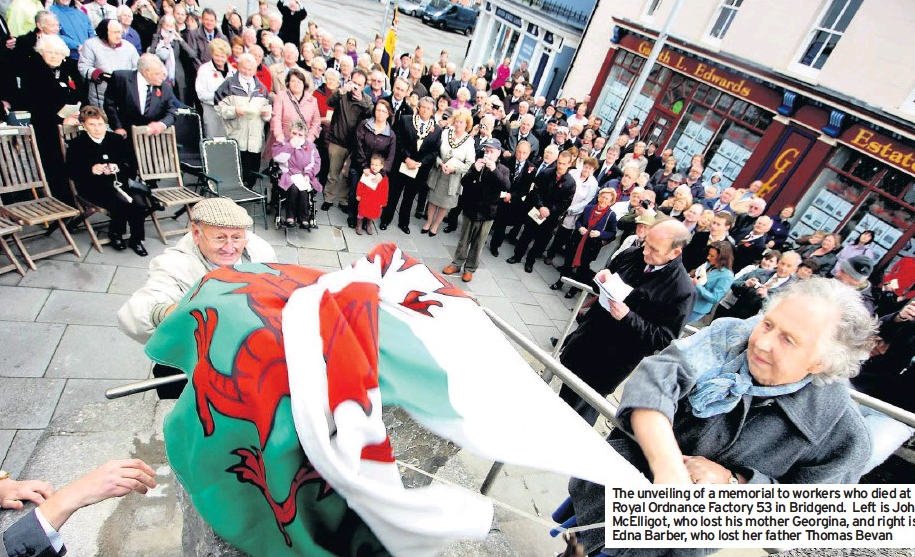
His love of history was given a particularly local flavour when he took a significant interest in the lives of the people, up to 32,000 of them, who worked in the arsenal in Bridgend during WW2. Most of those people were women who were suddenly faced with employment opportunities and a wage – things not necessarily in great supply for women in the ’40s.
Dad wrote a book in 2007, ‘The Welsh Arsenal’, which kick-started a campaign to have the workers recognised for the part they played in the war effort.
Since the book was published, dad has spent countless hours of his evenings and weekends traveling the length and breadth of south Wales to educate others about this unique historical legacy; and to inspire others to take an interest in their own local histories.
Dad didn’t grow up speaking Welsh; he has learned it as an adult. So it was amazing to see him able to participate in an S4C programme about disability recently. His grandchildren were delighted too (apparently being on telly still has some caché even for kids today!)
My dad’s obvious love of history, and his passion to share it with others, is simultaneously both mundane and extraordinary.
It’s mundane only in the way that, across Wales, hundreds of thousands of us volunteer in our own ways every day, making life a bit better for people in our local communities, or communities of interest further afield. In other words, it’s ‘commonplace, ordinary’.
But what an extraordinary gift of love and mutual cooperation.
From the local history societies, civic societies, local museums, to the environmental organisations that are showing a path to local activism and love of nature, to every form of social, community, health and sporting activity. Our lives are supported by the invisible threads of generosity of spirit, of time, and frequently of money.
You may have heard people say that society doesn’t matter. That only economics matters, only markets matter.
They couldn’t be further from the truth. Not only is the current system broken, using the commons as a convenient place to dump pollution, and harvesting financial wealth as a compensation; but a market-driven approach, with every transaction needing to carry an equivalent monetary exchange, can never provide the rich experiences that humans need to fulfill their true potential.
Next time you hear someone talk about ‘consumers’, remember that they really mean people; and each of us has our own part to play in forging a better society.
The wonderful people who give freely of their time, energy and love are worthy of our huge thanks. So here’s to my dad, Mike Clubb, and to everybody like him who gifts their time within their local communities across Wales and beyond.
Could 50°C in the towns and cities of Wales be liveable?
(Spoiler – yes – and with a lot of strategic thought and hard work could be far nicer than our towns and cities of today. They could be glorious 🌟🏴 Read on to find out how 👇)
Review double yellow line areas with a view to incorporating trees where they do not interfere with road safety (incorporating SUDS or other low-level green infrastructure if trees would cause significant street use risk)
Prohibit the removal of trees with Tree Preservation Orders for the purposes of facilitating or enabling new developments
Assess every street for the potential to integrate new trees, focusing on streets that are furthest from existing green space first
Remove 10% of on-street parking places on streets that are not currently suitable for urban trees, to enable street furniture and trees to be integrated
Local authorities be required to set ‘shade standards’
Build a community movement to reshape gardens to be part of the solution
Lessons from southern Europe
If summer 2023 has shown us anything it’s that the impacts of climate change, so long felt as theoretical issues for far-off lands, are coming closer.
The evidence provided by geological studies enables us to put this level of atmospheric carbon dioxide into the context of the last several thousand years, which helps us consider why the ‘anthopocene‘ is a reality.
Perhaps even more fundamental to humanity is that high temperatures can dry out soil and vegetation, greatly increasing the likelihood that fires will take hold and spread, releasing huge amounts of carbon back into the atmosphere, and devastating local ecosystems on a local or regional scale.
Once the soil ecosystems are significantly degraded, it is more difficult for ecosystems to recover, risking a downwards spiral in nature and habitat, unless active measures are taken to protect and enhance nature.
I remember in 2010 attending a conference in Poland where a German agronomist claimed that if southern Italy received 13 fewer days of rain annually, it would become a semi-desert and would be impossible to farm.
With overall global temperatures increasing, we should use southern Europe as an example of what might come to us in the years and decades ahead. Our latitude gives us advanced warning of future impacts but it is only of use if we actually learn, and prepare ahead of time.
What temperatures are plausible in Wales?
In order to properly prepare ourselves, and our infrastructure, for the likely impacts of heating, we should assess the approximate range of temperatures under consideration.1
Current models show that Wales will experience an additional 1.34°C of average heat by . However, the records tumbling on an annual basis point to something far more serious; the likelihood of extremes of weather are significantly greater than the average temperature increase would suggest. As the Met Office puts it:
extremes of temperature are changing much faster than the average temperature.
The same Met Office report points out that the 2022 heatwave would happen once every 528 years in the absence of human-induced climate change, and is now likely every 3.4 years.
By 2060, under scenarios that assume reductions in carbon emissions (that do not seem that likely under current political and economic systems), the 2022 heatwave would be considered an average year, and by 2100, it would be a cool year.
The lifespan of green, blue and grey infrastructure in Wales takes us, roughly speaking, to the period 2050-2100. Trees can take decades to reach maturity. Hard infrastructure has a design life of decades. It would therefore be prudent to start examining what can be done now to prepare for regular summer temperatures of 40-50°C, particularly in urban environments which face additional challenges in maintaining habitable temperatures.
Green infrastructure can alleviate heating, and also plays a role in mitigating climate change. A recent Public Health Wales report highlights the impact that climate change will have on health and well-being in Wales:
Public Health Wales NHS Trust (PHW) recognises that climate change is one of the most significant threats of the century, endangering physical health, mental health and wellbeing. It threatens all areas of life that impact our ability to achieve and maintain good health.
Public Health Wales
Heat, and overheating, is a constant theme in the Public Health Wales report, emphasising why this topic needs adressing with some urgency.
Why are urban areas particularly susceptible to summer overheating?
Hard, dark surfaces absorb and the radiate heat back into urban areas
High population density in urban areas increases the amount of heat-generating activities per unit area. Air conditioning cools single buildings or vehicles but adds another heat load to the external environment
Urban areas typically have less vegetation than rural areas. Plants provide shade, and also evapotranspiration to cool the surrounding areas
Buildings can modify air flow, trapping or releasing warm air to surrounding areas
The BBC has a tool to determine how likely your home and neighbourhood is to suffer from extreme heating. Counter-intuitively, even rural towns like Machynlleth could experience high urban heating in their town centres, and should also consider green infrastructure interventions where possible, although cities will experience heat outcomes that are more complex and challenging to resolve.
The most immediate solution to overheating in buildings is air conditioning. Which certainly treats the symptom in that particular building, but exacerbates the problem of climate change (uses electricity and other raw materials in manufacture and use), and increases heating outside the property by ‘dumping’ the heat into the urban environment.
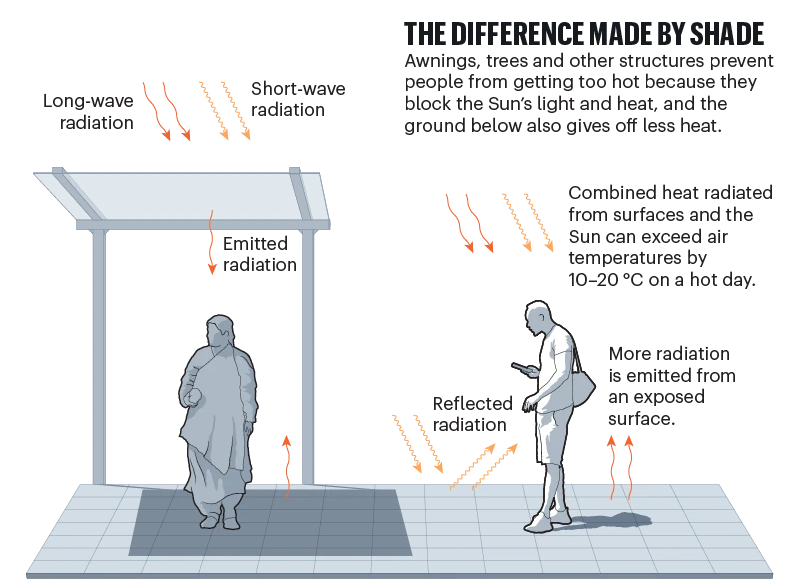
A more holistic solution is to shade our urban areas.
Image from an article on urban shade by Nature.com
Urban shade is provided by buildings and trees. Buildings provide temporary respite from heat by providing shade, but they generally absorb the heat and re-emit into surrounding areas, raising overall heat levels. Trees and other green infrastructure provide shade and additional cooling through evapotranspiration. Although the built environment could certainly be improved to provide more shade and allow greater air flow, by far the biggest improvement in urban shade would be to greatly increase the urban canopy by planting more trees and providing greater protection for existing trees.
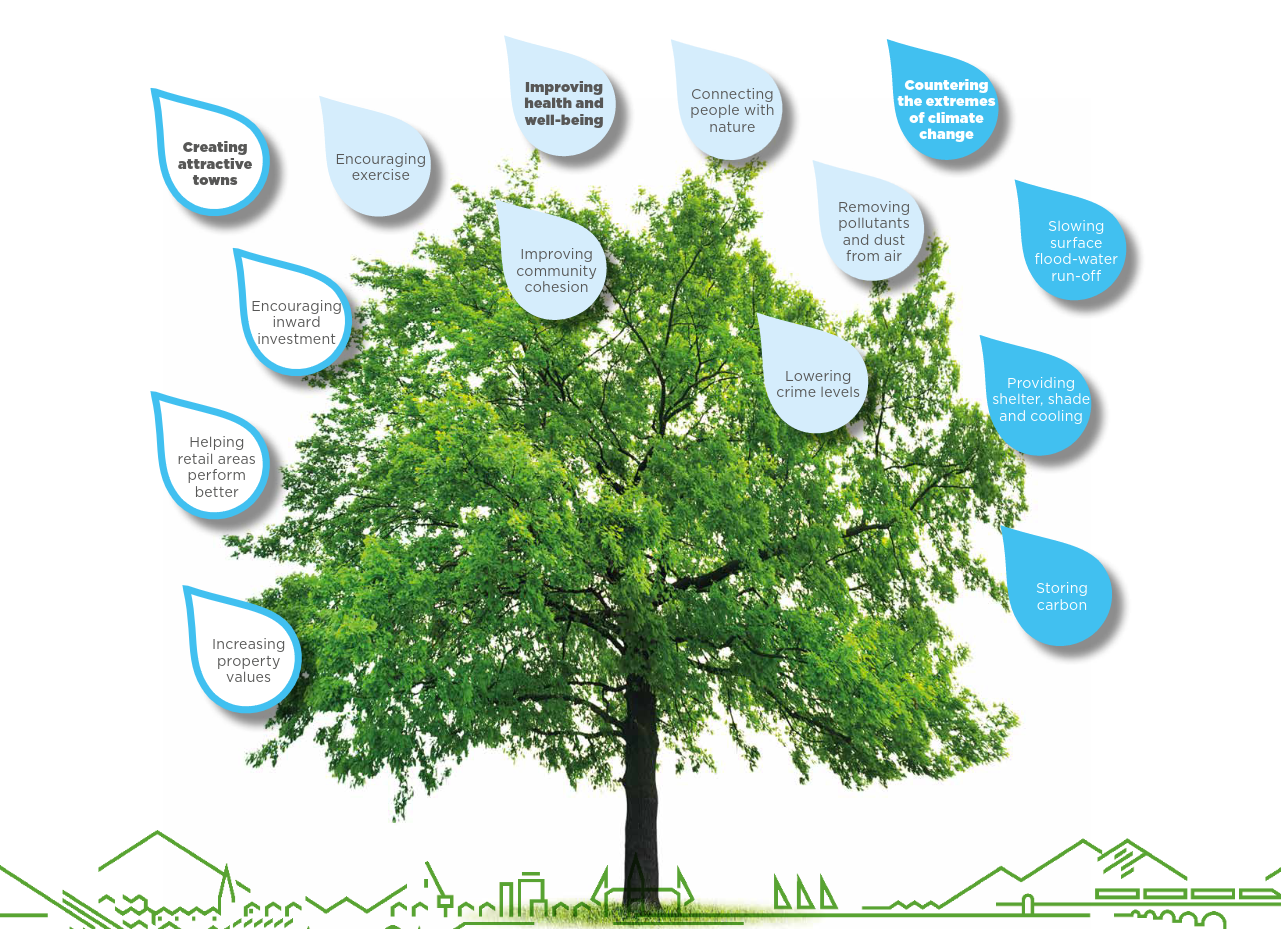
Urban trees provide a huge range of benefits, as described in the image below. They are the focus of the solution I propose for urban heating in Wales. The reason for focusing on them now is because they take a long time to mature, with the benefits increasing as they grow; and because the co-benefits of urban trees are so compelling.
Worryingly for those who would like to see more natural shade, the prognosis is not good:
Whilst there has been little change in canopy cover between 2013 and 2019, the number of trees over this period have decreased overall and the figures show an ageing population of urban trees which is not being replenished.
Although this blog post focuses on using trees to create shade, it’s also worth pointing out that water bodies contribute to urban cooling. Which is why Cardiff Council deserves credit for their scheme to open up some of the old canal that used to run through the city.
Suggestions to prepare Wales’ urban areas for a hot future
Protect what’s already there
I understand from somebody within the woodland sector that trees with Tree Preservation Orders are routinely consented for destruction when planning applications come before local authorities. If true, this makes a mockery of the Tree Preservation Order purpose, and runs contrary to a number of Welsh Government priorities.
Given the life-threatening nature of likely future heating, I propose that trees with Tree Preservation Orders in any urban area indicating extreme heat risk are not eligible for removal for the purposes of enabling new developments.
Assess existing ‘hot spots’ for potential new trees
Given the urgency provided by the Climate Emergency, and the trend of a reduction in the number of urban trees, an active Wales-wide programme of creating new urban trees would seem to be a no-brainer.
Using modelling to highlight ‘extreme heat’ areas, sites should be identified to install new trees where the current risk is greatest, and where the future benefit will be maximised. Where streets are not currently suitable for siting trees, 10% of on-street parking should be removed in order to enable new trees and integrated street furniture to be embedded.
Assess double-yellow line areas for integrating new green infrastructure
I’ve noticed a number of areas near where I live that have double-yellow lines, and have become more or less functionless from the streetscape perspective. If that’s the case in ‘my’ part of Cardiff, it’s likely replicated to a certain extent across other urban areas.
I understand that they are likely to be restricted for parking to enable better views around corners, but perhaps some of them might be suitable for integrating street furniture and/or trees or other green infrastructure, instead of having to remove on-street parking?
A street in Canton, showing double yellow lines. Maybe acceptable for some green infrastructure near the existing on-street parking?
Shade standards for at-risk urban areas
Local authority areas in Abu Dhabi, Tel Aviv and Arizona have set shade standards to enable urban living in hot environments.This sort of future thinking should be integrated in urban areas in Wales which are categorised as ‘at risk’ from extreme heat.
Abu Dhabi’s Public Realm Design Manual calls for “continuous shade” for 80% of primary and 60% of secondary walkways, shaded rest areas at regular intervals and 100% shade coverage for all formal play structures in public parks. Tel Aviv’s Shade Planning Guidelines recommend continuous shade on 80% of public streets, paths and walkways, and 50% shade in school playgrounds.
Although some of the levers for the urban green infrastructure revolution rightly lie with local authorities, Welsh Government, Natural Resources Wales and other large organisations, the full potential of our urban areas will only be realised when we tap into an empowered and educated community.
A signifcant contribution to the change in streetscapes towards more green infrastructure could be delivered from those domestic properties that have front gardens. It’s something I’m implementing myself – fruit trees to give partial shade in summer but allow most of the light through in winter. Wisteria, hops, jasmine, grapes and other climbers to provide some natural shading, again just during the warmer months.
I can imagine programmes of street-level activity for domestic properties to be carried out nation-wide in urban areas targeted as at risk for urban heating.
This grass-roots activity could be supported by water companies (for helping with water body cleaning and reducing combined sewer overflow), local authorities, health boards (improved well-being will reduce future health expenditure) and Welsh Government (supports many outcomes). I’m also a fan of land value taxation; this system could help increase revenue from areas that already benefit from excellent green infrastructure, in order to support areas at risk of extreme heating.
Civic and community organisations would be very valuable participants, bringing their specialist local knowledge, as well as sector-specific understanding not necessarily available to environmental organisations.
Who’s doing urban trees well?
When I used to work in the woodland sector, the Red Rose Forest was widely recognised as a pathfinder in this sector. It has now been rebranded as Manchester’s City of Trees
Urban Forest – a community organisation in south Manchester looks interesting
Non-heating issues
Some of the interventions suggested also have wider benefits. For example, urban trees, in addition to providing cooling:
Look nice
Improve mental health and well-being just by being part of the townscape
Improve air quality by scrubbing particulates and harmful gases
Urban trees can be integrated with street furniture to provide huge amenity to a wide range of residents and visitors. Street furniture, particularly shaded furniture, is a key enabler for people to participate in urban life if they experience challenges in walking, are carrying shopping, engaging with young children etc.
The suggestions made in this blog post are provided in the luxury of not having to bear in mind any policy, legal, financial or practical implications for implementing them.
There are likely a myriad of challenges to implementing them, not least with educating people about the reason for changes in the streetscape, keeping trees alive in urban areas, removal of parking to allow street furniture and/or trees, removal of leaves in the autumn etc.
The suggestions are made as a way to stimulate discussion about ways in which the objective of liveable urban areas in Wales by 2100 can be provided that give the maximum climate, nature and health benefits.and community benefit.
Could 50°C in the towns and cities of Wales be liveable?
I believe that the answer to this is a resounding ‘yes’ – but it will take a lot of strategic vision, and a genuine approach of reinventing our urban areas as places where nature and the built environment work in harmony.
I can see a future for Wales’ towns and cities which is far more liveable than our urban spaces today, even pricing in big challenges arising from climate change. These towns and cities will be designed to address heat and heavy rainfall using natural solutions as the default, with other built ‘hard’ structures only where nature is not able to deliver all the solution. Our towns and cities could be truly wonderful places to live and visit.
I look forward to working with others to make the vision a reality.
Footnotes
This is, of course, an inexact exercise, complicated by the non-linearities inherent in a complex system. For example, we don’t yet know how much the Atlantic Meridional Overturning Circulation (AMOC) will weaken this century, or whether it will collapse completely. If it does, it may offset some of the ‘generic’ heating impacts of climate change. The subsequent shift of heat to the south pole could massively increase ice cap melt, raising sea levels and rendering the population centres of Wales – and neighbouring cities in England uninhabitable, except, I guess, by marine creatures. ↩︎
Full reference “Hodges, C. 2020. Tree Cover in Wales’ Towns and Cities: update 2020 – Updated information to help us understand canopy cover to better plan and manage our urban trees. Report No: 465, 26pp, Natural Resources Wales, Bangor (Gwynedd).” ↩︎
There was an interesting thread on LinkedIn last week, discussing things like Wales’ relience on imported fruit and vegetables. Predominantly Brexit-related issues, but it did spark a few comments about what Wales could and should be producing. And it led me to consider whether public procurement in Wales should only incorporate vegetarian or vegan products 🤔
So, after posting on LinkedIn that I was thinking about starting a petition, I did it.
Petitions in Wales
The petition functionality on the Senedd website is really user-friendly. I think that this system can help our elected representatives judge the mood and salience of particular topics, and it also helps citizens feel as though topics of interest are being properly considered, and could even be debated in the Senedd.
The process was straightforward; write some text about the petition, along with any supplementary information. Then find two people who are prepared to support your position.
We know that around £85 million worth of food is procured by the public sector in Wales every year. This presents a brilliant opportunity for Welsh food producers. It also provides public bodies with an opportunity to influence the eating experience and the health of some of the most vulnerable in society (including people in hospital and people in schools); and to influence the strategic direction of food and agricultural policy in Wales.
My petition asks the Senedd to consider making all public procurement of food in Wales vegetarian or vegan, and there’s a few reasons for that.
The climate impact of meat
The fact that meat products produce much greater amounts of greenhouse gas emissions is well known.
A 2023 WCPP report highlighted that farming in Wales consists of mostly sheep and cattle grazing, with just 6% of farms devoted to crops and horticulture. This is despite the classification of 20% of land in Wales as grades 1-3a in the Agricultural Land Classification, defined as ‘best and most versatile’, that can sustain food and non-food crops.
Only 5% of the beef and lamb produced in Wales is eaten here; most is eaten in the rest of the UK, with significant amounts exported.
Astonishingly, given the increasing awareness of the climate crisis, emissions from agriculture in Wales have increased since 2016.
If the public sector in Wales procured only vegetarian or vegan food, it would signify a strong policy shift, and help support fruit, vegetable and dairy producers in Wales.
Some hospitals in England have recently been discovered to have been serving meat with chemicals associated with the development of cancer.
Eliminating meat products from the procurement chain of the public sector would improve the health choices of thousands of people in Wales, improving the long-term outcomes for individuals, and also for demand on the NHS.
Use your democratic mandate!
If, like me, you believe that every policy lever on health, well-being and climate change, needs to be pulled simultaneously, it’s hard to get away from the fact that Wales’ agriculture system will need to be re-tooled, away from predominantly meat production, and towards more fruit and vegetables.
The Senedd petitions platform gives the people of Wales the opportunity to pressure politicians directly about the sorts of changes we believe need to take place.
I’d appreciate you lending your support to this petition 🙏🙇
Update 5 September
One of my friends kindly brought to my attention that a similar call has been made by hundreds of academics, to the food served by UK universities. The link to the Guardian article is here.








4 responses to “Must Everything Go? The Prospects for economic (re-)localisation in Wales”
@admin @calvjones
@davidoclubb @admin @calvjones you can more readily affect what’s close, especially if primed.
Part of the growth, of ‘post growth’ economics has been the #WFGAct – but now it needs a reservoir of watering.
A way to do that, get the Welsh public bought in to it.
Wellbeing economics can readily appeal to our intrinsic higher values, especially now, when it’s got real hard to ignore the world’s abused by billionaires hands, & how their money has corrupted power structures, our communities.
@nspugh @davidoclubb @admin @calvjones it may sound peripheral, but self-esteem can be rocket fuel in economic development. It is beyond time for both of the Welsh and English to realise that the basis of English grammar is essentially Welsh, not Anglo-Saxon.
I cannot help but think that once there is a general realisation that English is essentially bastardised Welsh the attitudes of each country toward each other will undergo a sea change.
@admin
https://youtu.be/y4CA8p3OLvc?feature=shared