Blog

  • Reflections on renewables

    Reflections on renewables

    I joined RenewableUK in June 2012 and left in March 2019. This blog post provides some reflections on my time with the organisation. To hear my thoughts on a wide range of issues, head to the Cardiff Podcast where I chat about climate change, feminism, the energy sector in Wales and my new venture, Afallen.

    Today marks the end of my employment with RenewableUK, the UK’s pre-eminent not-for-profit trade body for clean energy, and the only one with a staff presence in Wales. Nearly seven years after my move from the European Environment Agency in Denmark, I’m taking my next steps in my career — this time, one that I’ve defined for myself (more on that in a future post!)

    I’m taking the opportunity to reflect on some of the changes that have taken place over those seven years, and on the challenges that lie ahead. After all, although renewables are now one of the dominant forms of electricity generation, we still have to get to grips with powering our transport and heat with renewable energy if we’re to have any hope of meeting our legal and moral obligations to a low-carbon society.


    The change

    The sector has seen astonishing changes over the last seven years — both at a UK level, and in Wales. Most interesting for me is the change in political and media attitude to renewables over that time, and the divergence in approach to renewable energy between the governments of the UK and Wales.

    ‘Renewables’ in the media is usually a proxy to talk about onshore wind, a technology supported by the vast majority of citizens of the UK (demonstrated time and again by UK Government polls), yet one described almost invariably by the media as ‘controversial’. Perhaps in the same way as brussel sprouts on the plate at Christmas being ‘controversial’, in that a tiny proportion of the population are highly exercised by it; but not in the least controversial across the population at large.

    Graph showing the change in support levels amongst the general public in the UK, from March 2012 to March 2018.

    Despite my continuing frustration with many media outlets about their representation of onshore wind, the situation in Wales has greatly improved. In 2012 the general tone of debate was hostile, with a number of journalists — yes at some small publications, but also at national outlets — making little secret of their hostility. Perhaps this was partly down to the extreme politicisation of the topic, most notably by Russell George and Glyn Davies, which led to the famous protest outside the Senedd in 2011. 

    However, onshore wind has now become accepted by most communities and the media in Wales as infrastructure necessary for the benefit of future generations. Again, as a proxy for all renewables, this is extremely important, because without widespread acceptance, we cannot take the steps we know are necessary in order to prevent the very worst impacts of climate change.

    This is not to say that questions around the appropriateness of onshore wind are still not leveled — listen to my recent interview with Radio Cymru (with subtitles) where I field the assertion that wind turbines are ‘ugly’ — but this tends to happen less frequently. 

    Policy

    Policy in Wales has also seen huge changes over that time. Those with long enough memories will recall the discussions around the Silk Commission, and transfers of powers for consenting energy projects to Wales from Westminster. Indeed, our own members were not convinced by the idea, some preferring the idea of UK Ministers making decisions over the ‘lottery’ of local authority or Welsh Minister determination.

    How times change. In the intervening years, in Wales, we have witnessed the adoption of the Environment Act and the Well-being of Future Generations Act and — today — the launch of the low carbon delivery plan. And simultaneously at the UK level, we’ve seen a cooling of support for funding renewables generally, and a huge political and policy surge for that most unpopular of technologies, fracking. As I put it in 2016, Wales and England seem to be very different shades of green.

    Graph showing the change in levels of support for fracking in the UK from December 2013 to December 2018

    Our members would, I suspect, strongly oppose any idea of consenting powers for energy projects making their way back up the M4. I posed the question in 2015 as to whether decisions taken by the UK Government were making nationalists of the business community. Certainly, insofar as the direction of travel of sustainability, their policies may well have had the impact of shoring up support for the institutions of government within the devolved administrations.


    Wot no lagoon?

    Probably the biggest disappointment during my time at RenewableUK was the decision by the UK Government not to provide financial support for the Swansea Bay Tidal Lagoon project, at the same time as it was bending over backwards to guarantee eye-wateringly lucrative payments for the nuclear sector (and yes, the evidence shows that a policy environment supportive for nuclear is less supportive for renewables)

    An image of the front page of the Hendry Review website

    In 2015 I wrote — before the outcome of the Hendry review was known — that a Wales without lagoons would be poorer, dirtier and sadder. When the review was finally published by UK Government, it described supporting the Swansea project as a ‘no regrets’ option. Indeed. All the more baffling for the sector — particularly bearing in mind the support that the nuclear industry had been promised — when that same support was not extended to this global pathfinder. I described that decision as unjust, and the resentment engendered by it still lingers in Wales — and will continue to do so, I suspect, for many years to come.


    Subsidy for a mainstream sector?

    Few would argue that renewables have entered the mainstream as a major power producer. Indeed, those that would argue do so in face of the facts; in 2018 the output from renewables overtook the combined output from coal and nuclear. 
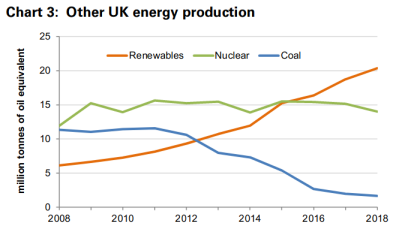
    Fuel sources for electricity in the UK from 2008 to 2018 (excluding gas)

    It’s a trend which looks certain to continue, with the costs of renewable energy continuing to fall, and with UK Government support for offshore wind guaranteed for the medium term under a Sector Deal. Given this strong support for our offshore colleagues, it’s all the more disappointing to still be waiting for any sign that our nascent marine energy sector will see any kind of revenue support. And equally disappointing that the cheapest forms of electricity generation — onshore wind and solar photovoltaic — continue to be excluded from competitive auctions for subsidy.

    Let us not forget, in the discussion about subsidy, that fossil fuels in the UK receive subsidies of around £15bn per year on average. Offshore wind will receive £557m per year under the sector deal, and large-scale onshore wind and solar will receive zero.

    Given the headstart obtained by the nuclear and fossil fuel sectors, it’s astonishing to me that they should receive any subsidy at all. I would love to see those figures reversed. Let’s invest in our future instead of propping up our past.


    Heat and transport

    If electricity is a job partly undertaken, what of heat and transport?

    It’s no surprise that neither sector have decarbonised significantly since 1990, wedded as we are to the infrastructure that supports the processing and distribution of the fossil fuels which underpin our heat and transport systems. The Committee on Climate Change gave their suggestions for Wales’ emissions targets for 2050, and specifically highlighted planning as an area which could tackle both heat and transport. How disappointing, therefore, to see developments continuing to spring up around Cardiff with little or no obvious mechanism to transport people and goods, except for the private automobile. We seem to be putting an awful lot of faith in the laissez faire approach to market development in clean transport, and insufficient regulation into obliging our developers to make our communities genuinely sustainable.

    That’s not to say that we haven’t made progress — the latest version of Planning Policy Wales is a major step forward. And yet those housing developers who obtained their planning permission many years ago, and have been sitting on their precious land banks; they will be able to build to the same crappy standards they’ve been using for decades, condemning the occupants to a lifetime of high fuel bills. What power does our Future Generations Act have in preventing this? I call for a sunset clause on planning permission in the built environment — or at least a requirement for developers to adopt the latest building standards when they finally get around to developing their sites.


    Final thoughts

    My final comment is to urge you as an individual — and as an organisation — to sign up to your trade body or union. Our sector would undoubtedly be the poorer without RenewableUK’s policy, advocacy, media and networking activity. Even though I will no longer be an employee of RenewableUK, I will be tireless in advocating membership for it. Whatever your sector, there is (probably) a union or a trade body for you. Your membership enables the functioning of that organisation, to the benefit of the sector.

    As an organisation, we are as flawed as any. But what wonderful, talented, inspirational and committed individuals they are that make up RenewableUK, and what an amazing difference this organisation has made to the sector, and to our society. 

    Wales, and the UK, are more prosperous, cleaner, and are stronger global players in the discussion around climate change because of the action of RenewableUK and other trade bodies in the sector — and, of course, because of the member organisations who make up those trade bodies. Colleagues in the energy sector, I salute you and your perseverance. My very best wishes as you continue to make this world a better place.

  • Bancio da

    Bancio da

    Mae Afallen yn sefydliad sy’n seiliedig ar werthoedd. Rydyn ni am newid y byd er gwell, ac er mwyn gweithredu’n gyfan gwbl, mae hynny’n golygu – lle bynnag y bo’n bosibl – y mae angen i’r gwasanaethau a gawn ni adlewyrchu ein gwerthoedd.

    Dyna pam yr ydym yn falch o fod yn gweithio gyda Banc Triodos sef y darparwyr ein gwasanaethau bancio.

    Mae gan Triodos enw da byd-eang fel arloeswyr mewn bancio moesegol. Maent yn cymhwyso meini prawf caeth i ymgeiswyr am gyfrif banc busnes er mwyn sicrhau bod eu cwsmeriaid yn gweithredu mewn ffyrdd sy’n gydnaws â’u gwerthoedd eu hunain; sef cynaliadwyedd, tryloywder, rhagoriaeth ac entrepreneuriaeth. Maent yn un o grŵp dethol sydd wedi ennill statws ‘Wyau Da’ (gweler y chwith).

    Aethpwyd ati i basio’r meini prawf dewis yn llwyddiannus ar gyfer cymhwyso banc gyda Triodos ym mis Chwefror 2019, a byddwn wrth ein bodd yn mynychu’r Cyfarfod Cyffredinol Blynyddol ym mis Ebrill. , sydd hefyd yn rhoi’r cyfle i ni rwydweithio gydag arloeswyr cynaliadwyedd eraill.

    Os hoffech chi ddarganfod mwy am sut y gall ein hymagwedd at gynaliadwyedd sicrhau canlyniadau gwych, sy’n cael eu profi yn y dyfodol, dim ond gollwng llinell i ni.

  • Banking for good

    Afallen is a values-based organisation. We want to change the world for the better, and in order to operate with integrity, that means that – wherever possible – the services we procure need to reflect our values.

    That’s why we’re proud to be working with Triodos Bank who are the providers of our banking services.

    Triodos have a global reputation as pioneers in ethical banking. They apply strict criteria to applicants for a business bank account in order to ensure that their customers act in ways which are sympathetic to their own values; namely sustainability, transparency, excellence and entrepreneurship. They are one of a select group who have been awarded ‘Good Egg’ status.

    Afallen successfully passed the selection criteria for eligibility to bank with Triodos in February 2019, and we will be delighted to attend the Annual General Meeting in April, which also gives us the opportunity to network with other sustainability pioneers.

    If you’d like to find out more about how our approach to sustainability can secure superb, future-proofed outcomes, just drop us a line.

  • Infrastructure in Wales

    Infrastructure is the Cinderella of modern society. Underpinning every activity we undertake, it is nonetheless largely taken for granted, except when it isn’t there.

    It’s the job of policy-makers and planners in the public sector, and their counterparts and engineering professionals in the private sector, to ensure that infrastructure is robust and accessible round the clock. To their credit, there are very few times when this part of the system fails.

    It’s also the job of those same people to ensure that society’s future demands on infrastructure can be met, which requires direction and investment. The ambit of future scenarios is fascinating, in that it affords both great challenge and great opportunity for our infrastructure — and by extension, for society as a whole.

    But it’s my personal fear that we are failing to meet the challenges and obligations set to us by our future generations.

    Gridlock

    Foremost amongst my areas of concern is our electricity grid. The capacity in Wales, both in distribution and transmission, is completely full. This means that most new renewable generators face punishing costs to upgrade large chunks of the system, leaving many projects unviable.

    An electricity pylon at night with stars in the background

    In mid Wales, the situation is particularly severe. This is where Wales’ most productive and dependable wind resource is literally stranded, pending the development of the mid Wales connection. This 400kV connection would greatly facilitate Wales in meeting its own renewable energy targets, but is itself dependent on the ability of onshore wind — the cheapest form of renewable electricity — to access the market.

    Mid Wales is doubly-penalised; insufficient grid to generate and export renewable energy, and potentially insufficient grid — ‘grid poverty’ — to make use of new technologies such as electric vehicles and heat pumps. As I wrote in 2017, this lack of access to potentially money-saving technologies has the potential to further disadvantage rural dwellers, and could lead to communities becoming increasingly dependent on unaffordable ways of heating and transport.

    However, although the position in mid Wales is particularly acute, the grid is squeezed everywhere. I have been told by the two Distribution Network Operators in Wales that no new thermal generation or battery storage greater than 1MW can be installed until 2026.

    This limitation is crippling our ability to take part in new energy and economic systems, once again condemning Wales to use legacy 20th century infrastructure as our UK neighbours move seamlessly into a more enlightened system of low-carbon generation, storage and smart use.

    Opportunity

    Wales is at a crucial point with respect to a range of infrastructure issues, and rural Wales, in a Brexit landscape, is particularly vulnerable.

    However I believe that within this uncertainty lies opportunity. With Wales’ rural areas replete in notorious ‘not-spots’ for both mobile signal and 4G internet, could we combine new grid infrastructure with 5G mobile networks, leap-frogging old technologies in ways advantageous to rural livelihoods?

    Why shouldn’t Welsh Government — and other public sector organisations — take a stake in the grid infrastructure which would be needed to connect much-needed onshore wind projects, facilitating the development of renewables in Wales and simultaneously providing opportunity to a whole host of modern, low-impact manufacturing and processing clusters across rural Wales?

    A cyclist on a small road in the hills, fading into mist in the distance.

    Could the proposed ‘Lôn Rhiannon’ also incorporate a grid line and future-proofed mobile network infrastructure, alongside a new cycle network, up the spine of Wales?

    With the new National Infrastructure Commission about to sit, there are a range of future opportunities which could change the way in which we view infrastructure. Multi-use, combined infrastructure, paid for in innovative ways and by new participants (crowd-funded grid anyone?) could unleash the creativity and enthusiasm of our citizens, businesses and public sector organisations. I cordially invite the new members of National Infrastructure Commission for Wales to use their imagination to the fullest when considering how best to serve the future interests of our people.

    And if they want some food for thought, my door is always open.

    (This article was first published on the Institute of Welsh Affairs website here.)

  • Swansea Tidal Lagoon; an unjust decision

    Swansea Tidal Lagoon; an unjust decision

    If we burn our bridges on tidal lagoons, our future will be a little colder and a little darker”.

    I wrote these prescient words in August 2016 as Charles Hendry was carrying out his research into the viability of tidal lagoons in the UK.

    Fast forward two years, and we now know that Wales’ most iconic infrastructure proposal, the Swansea Bay Tidal Lagoon, will not be receiving UK Government support. The statement, given to Parliament at 5pm on 25 June by Greg Clark, dashed the hopes of hundreds of thousands of supporters from across Wales and beyond, and has plunged the prospects of the project into doubt.

    The announcement seems to have been based on a six-page ‘value for money’ assessment, which has — to put it generously — inconsistencies in its assessment, and is a true wonder of brevity given that it took 81 weeks to produce following the receipt of the Hendry Review.

    The project, almost uniquely in Wales, received all-party support in the National Assembly, and also benefited from strong backbench support in Westminster. On receiving the all-clear from the Hendry Review — which called the Swansea project a ‘no regrets’ option — many thought that the project would receive the go-ahead.

    It was not to be, and the hopes of developing a global manufacturing and supply chain company, operating from southern Wales, with all the employment and skills opportunities that entails, have been lost.

    The already-wealthy regions of London and the south east of England benefit hugely from infrastructure spend via Heathrow and Crossrail. The citizens of West Wales and the Valleys, one of Europe’s poorest regions, could therefore be forgiven for smelling more than a hint of neglect having seen the cancellation of electrification of rail beyond Cardiff, and now the rejection of a tidal lagoon.

    On taking office as Prime Minister, Theresa May talked about the ‘precious, precious bond between England, Scotland, Wales and Northern Ireland’; and about being driven not by the interests of a privileged few. Many in Wales will wonder about the value of that bond, and the nature of privilege, when they look at wealth being distributed unto wealth in London, but see little evidence of it trickling westwards.

    What could have been

    It’s worth remembering what could have happened had the original timescale of Tidal Lagoon Power been met.

    The proposed timeline of development of the Swansea Bay Tidal Lagoon

    Having received its Development Consent Order in 2015, the project was more or less on schedule — pending environmental permits from Natural Resources Wales, and the decision on awarding public subsidy from UK Government.

    Had both the other pieces of the jigsaw been delivered that year, the project could conceivably have been generating electricity early in 2019 — just next year — with completion later that year.

    In stating that only 28 long-term jobs would be created as a result of the development, the office of the UK Government in Wales has stretched credulity beyond breaking point.

    Tidal Lagoon Power’s economic analysis — based on modelling carried out independently by the Centre for Economics and Business Research — suggest that the local and national benefit would have been significant.

    During construction, Swansea would have seen the creation of 2,232 direct jobs, and long-term there would have been 181 indirect and induced jobs. Swansea would have seen the impact of an estimated 100,000 visitors per year. With local hotel capacity overwhelmed, major tourism developments would have been likely — as well as the prospect of local AirBnB hosts benefiting from short stays.

    The opportunities for further development would have been impressive, with a prize of up to seven new manufacturing facilities in Wales helping contribute to 23,000 FTE jobs in Wales on completion of four project in Welsh waters. With a potential global market, the potential for job creation could have reached still further.

    Response

    There has been an anguished response to the decision from many quarters.

    Chair of the National Assembly’s Climate Change, Environment and Rural Affairs Committee, Mike Hedges AM, called it a ‘huge missed opportunity’, and ‘deeply disappointing and extremely concerning’. Stephen Kinnock, MP for Aberavon, called the announcement ‘devastating’.

    Simon Thomas, Plaid Cymru’s environment spokesperson, said that Greg Clark was ‘not just pulling the plug on this one project but on the whole potential of tidal range energy in Wales and the UK’.

    The Welsh Conservatives called the decision ‘depressing’. And Grenville Ham, leader of the Green Party in Wales, summarised it with “Wales wants a dam, UK Govt doesn’t give a damn”.

    From the business community, FSB Wales said they were ‘bitterly disappointed’, South Wales Chambers of Commerce called the decision ‘short-sighted’ and a ‘bitter pill’.

    We have yet to hear from Tidal Lagoon Power itself, so we can only speculate as to whether the company will proceed with the Swansea — or any other — tidal project.

    Conclusion

    The UK Government said that the project did not meet the three tests of having dependable electricity, provided by low-cost and low-carbon sources.

    In making this decision, the UK Government seems to have used double-standards on comparing the lagoon with nuclear. For example, in only considering capital costs, the decommissioning cost of nuclear has been conveniently air-brushed from the equation. That’s 100 years of employment plus capital expenditure quietly deleted. In comparing output in TWh, and then bringing up Capacity Factor, they have conflated two issues which don’t belong together.

    The comparison with offshore wind, a mature market which benefited from generous subsidy to become established, is also unfair. The proposition with the lagoon is not solely based on electricity cost, but the potential to generate a whole new industrial sector.

    And on cost, how on earth did the UK Government come to the conclusion that the cost to Welsh householders would be £15,000, when the Hendry Review said that the cost would be a pint of milk to every household in the UK per year?

    It’s as if there are two lagoons in Swansea.

    The first, promoted by the company and recognised by every Welsh political party and the independent Government-commissioned Hendry review, produces affordable electricity for a hundred years, kick-starts a local economy, and supports a manufacturing and supply chain to employ thousands.

    The other, recognised only by the UK Government, employs 28 people and bankrupts householders with unsustainable electricity bills.

    Whilst the truth is surely somewhere between the two, most reasonable people will recognise where the balance lies.

    This article was first published by the Institute of Welsh Affairs and does not reflect the views of my employer.

  • The Clubb Doctrine: presumed consent for community energy

    I’ve been working in the renewable energy sector since 2004. Of the thousands of people I’ve met during that time, I’ve never encountered anyone who opposed community energy.

    Even the anti-wind die-hards don’t generally object to community energy — as long as it’s not wind, natch.

    You’d think that with widespread public, civic and political support for community energy it would be ubiquitous. But it’s not. Not even close.

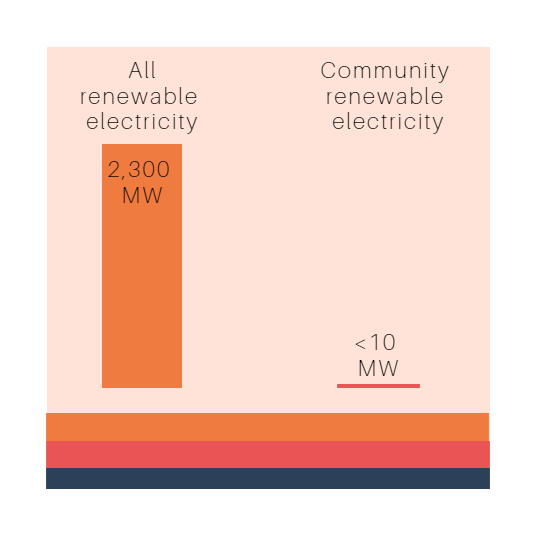
    Less than 10 MW of Wales’ 2,300 MW of renewable electricity is community-owned. That’s a miniscule 0.4%.

    Community energy in Wales has struggled to make much headway

    The problem

    The problems facing community energy project developers are legion. Not only do they encounter the same issues as commercial developers, such as negotiating planning, consenting, grid and financing issues; they have to do so with considerably less professional support .

    Those projects which have seen success are characterised by years of hard work from pioneering individuals who have doggedly pursued projects at no personal gain and against overwhelming odds. Take a bow everyone involved with Community Energy Wales.

    Community Energy Wales; struggling valiantly against the odds

    Sadly there are literally hundreds of projects which never made it to the grid. Many of these were perfectly viable, had huge local support, and could be generating low-carbon electricity right now, returning revenue to the local community and nourishing entrepreneurship, skills and employment.

    Rejection of a community energy project has sometimes been for fairly unenlightened reasons, such as the perception of visual impact by some of the local councillors who form the membership of planning committees.

    Appealing these decisions is often too much to bear for the meagre resources of a community project, and the idea, and all the good things embodied by it, can fall.

    The barriers, predominantly in the planning system, which for the most part serve to protect and enhance our built environment, are crippling the ability of our communities to benefit from the energy generated from our natural resources.

    The current policy levers have manifestly failed to add sufficient weight in the planning system to enable community energy projects to flourish. We need a new solution.

    The solution?

    Here’s my suggestion. Let’s reverse the normal way of doing things. Instead of considering genuinely community-owned projects as unwelcome intrusions into the landscape, let’s help them through the process. The time has come to put issues of project ownership into the planning system.

    Projects such as community energy installations — and indeed commercial/community partnership projects — potentially have such intrinsic value to society that we should challenge the planning system to say why they should not take place.

    Of course having a different planning process for community energy alone would be a needless bureaucratic burden if the existing system were able to provide the same outcomes. So I’m not proposing a separate system.

    Instead we should give material consideration to the ownership of renewable energy projects, such that considerable additional weight is given to a wholly community-owned energy project, or one which delivers significant local benefits through joint ownership models.

    We need to support community energy — and also commercial projects of all scales

    I’m most definitely not saying that we should make things any more difficult for commercial developers. The terrible imperative forced on us by the impacts of climate change mean that we should be pursuing every reasonable measure to mitigate future greenhouse gas emissions — which means being resolute in our determination to proceed apace with renewable energy deployment at all scales, including the very largest projects offshore and onshore.

    But community energy’s lack of success suggests that it needs a little extra if it’s to deliver anything substantial over the next few decades.

    Test it

    There are big conceptual challenges with a change to the system of this nature. So one possible approach is to take a discrete geographic area and pilot the approach.

    This area could be a local planning authority boundary, an enterprise zone, a city region or other target geography.

    Swansea Bay City Region. A potential target for community energy innovation? (Photo)

    Examples that spring to mind are the Swansea Bay City Region, the three energy enterprise zones (Ynys Môn, Haven Waterway and Eryri), the south Wales valleys (covered by the Ministerial Taskforce), the Dyfi Biosphere or Pen Llŷn.

    What would it mean?

    Presumed consent would immediately accelerate the deployment of community energy in Wales. The barriers would lower on a number of fronts:

    1. Reduced planning risk would incentivise more communities to consider developments in their area
    2. A greater material weight in planning would increase the number of successful projects, and lower the cost of all projects due to lowered cost of finance
    3. Any area which was identified as having better planning opportunities for community energy would attract significant interest, investment and expertise from within and outside those areas, increasing the number of project applications

    I believe that nascent models of commercial-community partnership should also be encouraged under this system. We could generate a very lively debate about the level at which ownership triggers the ‘material weight’ condition — although the detail of these important sub-aspects of the Doctrine would necessarily have to be explored in much greater depth once the principle was accepted.

    Potential issues

    The impact of a proliferation of community or joint-venture projects would need to be carefully and strategically managed.

    Local residents would need to be involved at all stages of the development of such a pilot, and the route to an easier ride through planning should require a quid pro quo of a binding commitment to local procurement.

    Strong links with the regional further education providers would demonstrate the career pathway for young people, further enhancing the positive reputation of the sector.

    However the potential downsides would — I believe — be strongly offset by the multiple advantages of having a thriving community energy sector.

    The philosophical barrier to progress

    When I’ve previously suggested presumed consent for community energy projects to people in the planning profession — I have form on radicalism — it has been met with something akin to disbelief.

    One of the fundamental tenets of planning is that projects should be judged entirely on their merit. Ownership of a project clearly has no bearing on planning issues such as visual impact.

    This means that — in suggesting that ownership of a project should have weight in planning — I am explicitly stating that one of these fundamentals of the planning system should be rejected.

    I don’t shy away from this.

    The exercise of planning policy in the community energy sector thus far has served the exact opposite. It has fed the process, and nearly obliterated the outcome.

    The planning system is not a divine precept. It is human-created, and should exist to serve the people.

    How do we make it happen?

    A pilot community energy zone will not happen of its own. We need to provide informed opinion which can challenge the philosophical objection to ownership having a material weight on a project. We also need evidence on how and why the current system is failing the sector

    I suggest that Community Energy Wales works with as many organisations as possible to build the case. This will almost certainly require the opinion of academic planners, practicing planners or legal experts, possibly supported by a crowdfund.

    With a well-crafted opinion, the sector will be in a place to make a strong case for a pilot zone.

    No doubt there will be plenty of devil in the detail; but the potential prize for the people and communities of Wales is unquestionable.

  • Our digital strategy; it’s yours too

    Our digital strategy; it’s yours too

    A long exposure photo of a person shining a torch into the starry sky at night

    Our digital strategy; it’s yours too (written as Head of Digital at RenewableUK)

    I’ve previously written about the process which we’ve undertaken to develop our digital strategy. 

    Since writing that article — and the previous ones about digital principles and our rules of engagement on social media — we have adopted the digital strategy and we’re on the implementation journey. 

    This article is written to help others on that journey by sharing our strategy (here’s the link) — not least because one our digital principles is “Openness as a Virtue”.

    A cropped image of a numbered list, with number 6 highlighted, emphasising openness as a virtue.

    Expectation management — the digital strategy that you’ll see is just the skeleton. It’s just words, a framework. The real impact arises from delivering the meaning behind them in a corporate (or NGO, public sector) environment.

    The platform

    First up, kudos to Notion. They have created a very useful platform which eliminates the pain of a wiki and puts editing and commenting into the hands of your average office worker.

    That’s important, because although I don’t *really* expect my colleagues to dive into this thing, it has to be as accessible and user-friendly as possible. One day I won’t be working for RenewableUK and someone else is going to pick up the mantle. Notion keeps things simple.

    A screenshot of a Notion page with arrows showing how different aspects of it can be interacted with.

    Navigating the strategy as a logged-in editor is reasonably intuitive — you just click on either the icons on the page itself, or on the navigation panel on the left. Nested pages can be exposed by clicking on the arrows on the left panel.

    If you’re a viewer only (which is the case with the strategy I’m sharing), you’ll get something a bit different.

    Gone are the menus and the drag’n’drop. You still have all the content though, and I’ve tried to make it reasonably straightforward to navigate by liberally scattering breadcrumbs throughout each of the content sections.

    A screenshot of a Notion page highlighting the 'breadcrumbs' at the top of the page, enabling simple navigation of the site.

    So while you won’t be able to edit the document directly, you’ll have in place a framework with a suggested bunch of content to get you off to a flying start.

    What’s not in it?

    An excellent question.

    Clearly I’ve redacted anything which created any commercial risk, so there’s a lot of stuff which isn’t in there.

    Top of that pile is our list of actions and beta projects. I have a brain fizzing with ideas, and have recommended around 20 discrete actions or programmes of work relating to digital. To date we are working on only about six of them.

    The entire list ranges from the trivial (using a shared spreadsheet via Google Sheets to share contact details of staff members internally), to the near-impossible (change our office software to GSuite and have Chromebooks instead of laptop PCs).

    I say near-impossible not because it’s technically difficult (that would be trivial) but because it require large cultural shifts. Unless you’re a small start-up, your organisation will most likely have ‘near-impossible’ digital adoption challenges too.

    It’s all about the culture

    If you’re anything like me, you’ll have heard the phrase about culture, strategy and breakfast a thousand times.

    "Culture eats strategy for breakfast" text on a black background

    Dead right. The organisational culture will kill a new initiative stone dead — or enable it to fly.

    Culture is determined by thousands of interactions between staff and with customers every day, and by the impacts of previous corporate decisions — in some cases —decades ago. 

    Culture is also a product of the political, policy and business environment that we currently experience at any given moment. Organisational culture is incredibly complex, durable and yet strangely dynamic.

    In trying to implement a digital strategy, it’s critical to understand the priorities of colleagues, and to empathise with their situation.

    That’s made a touch more difficult in that most of mine sit in an office several hundred miles away. This highlights the need for whoever is in charge of change management (me in this case) to be super-sensitive to my colleagues’ ability to take on new work practices and platforms at a time when they are stretched in different directions.

    It’s an awareness of the limits of people to handle change that gave rise to our Digital Principle number 8 — Voluntarity. 

    A screen grab of a numbered list, with number 8 highlighted: "Voluntarity; we encourage staff to engage, but only mandate where it is critical to business activity"

    In managing my frustrations at the apparent slow pace of change, I’m also the first to appreciate that we have come a huge distance already. Meetings at head office about ‘digital’ are better-informed than they were six months ago. Progress is being made on real-life projects. Our culture is slowly shifting.

    I’m not alone in dealing with change management. I know that Janet Hughes is working on cultural challenges, having identified digital leadership (or lack of) as a critical component. I also know that superb practitioners like Neil Tamplin, Dyfrig Williams, and renowned digital gurus like Paul Boag have experience and tools which can help speed the journey (if you haven’t come across Paul before, I strongly recommend you check out this YouTube video as an intro). 

    “The secret of change is to focus your energy not on fighting the old, but building the new.” — Socrates

  • Who fact-checks the fact checkers?

    Who fact-checks the fact checkers?

    Earlier this year Alison Hood was made redundant from Airvolution as a result of the UK Government’s policy shambles.

    Her communication skills and dedication to the cause are impressive, underlined by her winning the RenewableUK award for excellence at the Gala Dinner last week.

    Far from lamenting her position, Alison took the fight to the UK Government by launching a crowdfunding bid to fact-check the Energy Bill, to ensure that the Government was held to account on its stated objectives. 

    I not only donated to the cause, but I encouraged others to do so, because I thought that it was so important to hold the Government to account, and to do so in an independent, non-partisan way.

    Trouble in Paradise

    So far, so good. The project met – and exceeded – its target, and Full Fact were duly commissioned to undertake the work.

    Naturally I was extremely interested in seeing the outcome of the checks, so when the first update was posted, I was one of the first to read the results.

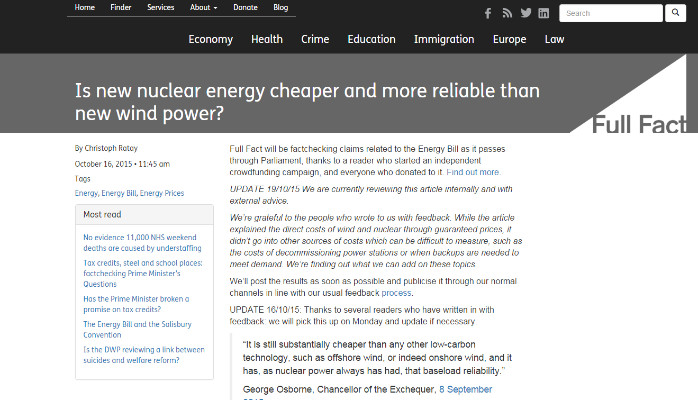
    Imagine my surprise and consternation to find that – apparently – nuclear is more reliable than wind.

    What Full Fact had done is taken the load factor for the two technologies and equated that to reliability. Patent nonsense; according to this approach solar energy is incredibly unreliable because the sun doesn’t shine in the night. Perhaps Full Fact assume there’s only a 50/50 chance it’s going to come back up again in the morning!

    It was a rookie error, and one I was happy to correct. So, following the guidance on the website, I emailed the team, and then tweeted with some information about Portfolio Theory which should have helped them understand their error.

    That was last Friday.

    To my great disappointment, the erroneous information is still up on the website despite correspondence to Full Fact from myself and a number of other individuals and organisations.

    Rather than note that there *might* be an issue with their conclusion and withdraw the section from the website, their only communication to me has been that they’re internally reviewing the statement.

    And all the while, people clicking on the page are blithely taking at face value the ‘fact’ that nuclear is a reliable choice, and that wind just lets us down time after time.

    It’s a terrible indictment of an industry which now generates more than 10% of the UK’s electricity, and does so reliably and incredibly cost-effectively.

    The naivety of Full Fact in allowing this slur to stand – particularly when it’s been pointed out by numerous sources – is astonishing. 

    The question stands; who fact-checks the fact-checker, and are they even listening?

    Update 28th October 2015

    It seems that Full Fact are at it again – this time on popularity of wind against other energy types. This time they‘ve taken a single Survation survey of 2013 to discuss the popularity of wind *against other renewables*.

    Two problems with this; firstly, their data source is crap. Why not use DECC data which publishes independent statistics on exactly this topic each quarter?

    (My mistake – they had used DECC data at the end of the article, sorry.)

    Secondly they’re only comparing renewables with each other. We know that renewables are insanely popular compared with fossil fuel and nuclear technologies, so it’s no surprise that onshore wind isn’t top. So why restrict the discussion to renewables alone given the title “What do Brits think about wind farms”.

    Perhaps Full Fact Partial Opinion have taken money from Alison Hood to carry out the work, but have a higher calling to support nuclear and fossil fuel companies?!

  • An energy policy for future generations?

    An energy policy for future generations?

    The general election of 7th May produced a result which was equally unexpected and unwelcomed by most in the UK.

    The surprise of the night was not that an unwelcome party was to form a new government – only once since 1931 has a government won more than 50% of the popular vote – but that it was the Conservatives who had won an outright majority.

    On the face of it, this could have been great news for the renewable energy sector. After all, this was the party led by David Cameron of wind turbine, husky and ‘greenest government ever’ fame.

    David Cameron, who used to ‘hug a husky’

    However, there were some ill tidings amongst the spin, not least the desire to ‘get rid of the green crap’, and the manifesto commitment to getting rid of new subsidies for onshore wind, the cheapest form of renewable electricity generation.

     It didn’t take long for the hostilities to commence.

    Within the first few weeks the government was consulting early closure of the Renewable Obligation for onshore wind, medium-scale solar, biomass co-firing and on the ability of projects to seek pre-accreditation for feed-in-tariff projects.

    Shortly afterwards there was the end of the Green Deal, the end of lower taxes for low-emission vehicles, the scrapping of the zero carbon homes plan  and the requirement for renewable electricity generators to pay the Climate Change Levy, a breathtakingly brazen counter-logical decision.

    In the face of this onslaught against one of the UK’s fastest-growing sectors, investors did what they’ve always done when faced with uncertainty; considered their choices and started to look elsewhere.

    Wales; a refuge from the storm?

    Wales hasn’t escaped the economic vandalism. Although planning and environmental permitting are devolved, the UK-controlled renewable energy subsidy is pivotal to the viability of projects in Wales.

     Unsurprisingly, projects are starting to be pulled. With around 40p of every pound spent on onshore wind projects coming to Wales, and the potential investment running to billions, the impact on direct investment and supply chains is colossal.

     Sadly, Wales-based companies, including those in the rural areas that the Conservatives profess to cherish, are also struggling to cope with the uncertainty.

     Dulas, one of Wales’ best-loved renewable energy companies, recently announced that jobs were at risk in Machynlleth, compounding the earlier announcement that Mabey Bridge of Chepstow was to close.

    Community energy projects are in disarray as the certainty they enjoyed from pre-accreditation for the feed-in-tariff disappears in front of their eyes.

     However, there are some ways in which the Welsh Government has acted to protect the interests of the people of Wales.

    Firstly, planning policy is devolved to Wales. So whereas the UK government has effectively banned onshore wind in England, the Planning Act for Wales will enable Welsh Government to determine decisions for projects between 25 MW and 50 MW in size, and also to take decisions away from local authorities which are seen to be performing poorly.

    Secondly the blanket hostility to the renewable energy sector from Conservative Ministers at Westminster is contrasted starkly by the fulsome support from Carl Sargeant, our Minister for Natural Resources. This contrast is not restricted to onshore wind; whilst the UK Government rushes to develop the shale gas resource (fracking) in England, it is likely to face a moratorium in Wales.

    Tweets from Carl Sargeant, showing leadership against vacuous UK Government policy 

    Devolution has required Welsh Ministers to embrace sustainable development, and the Bills and Acts for Active Travel, Future Generations and Environment are clear indicators of a Wales which is attempting to genuinely grapple with the complex issues which surround sustainability.

    And whilst we have undoubtedly scored some spectacular own-goals – the most obvious of which was the token improvement in energy efficiency in the last review of building regulations – the general direction of travel is hugely encouraging.

     Given that we will eventually see the devolution of energy policy to Wales with the passage of the next Wales Act, the likelihood is that the medium-term outlook for the sustainable energy sector in Wales will continue to improve.

    Towards 2016

    In June I predicted that the early activity from Amber Rudd would be pushing the business community of Wales and Scotland in a nationalist direction. I stand by that analysis, and conversation with people working in the sector reveals that they regard Wales and Scotland as potentially ‘safe havens’ from the whirlwind being created in Westminster.

    As we move closer to the elections in Wales, we will start to see whether the political parties of Wales step up in support of the sustainable energy sector. Early indications are encouraging with Plaid stating their commitment to a target of 100% renewable electricity in Wales by 2035, should they be elected to form the Welsh Government in 2016.

    This will – hopefully – start a sustainability ‘arms race’, in which the parties of Wales will be striving to produce a narrative for the 2016 election which appeals to one of the principal interests of the citizens of Wales, namely living within the limits of our environment.

    The National Conversation highlighted the importance of the environment to Wales 

    The UK Government’s energy policy is not worthy of the name. As the Financial Times stated recently, “sweeping away much of what the prime minister allegedly called ‘green crap’ is not on its own an energy policy”.

     Devolution is good for the people of Wales. Our renewable energy sector will be more productive and employ people with greater certainty than England. We will hopefully see improvements in energy efficiency regulation which upskill our workers and construction companies, and allow us to export more of our goods and services. And we anticipate much more activity in the fast-moving ‘smart energy’ sector, which have the potential to bring a whole new generation of businesses and entrepreneurs to Wales.

     The paths of Wales and England are slowly diverging. For the sake of the renewable energy sector, for the sake of sustainability, and for the sake of future generations, that is something to be warmly welcomed.

  • We owe each other a renewable future

    We owe each other a renewable future

    The Nuclear Decommissioning Authority has today announced its draft budget for 2015/16. The sum will be £3.31bn, of which £2.1bn comes from the public sector. That’s public money being used to subsidise electricity which has already been used.

    The cost for subsidising electricity via the Renewable Obligation, is around £2bn, with another 1/2 billion for the FIT, and – since we’re comparing – the latest estimates for fossil fuel support are around £4bn.

    All elements of our energy system attract subsidy. What I find distasteful is that the users of nuclear electricity over the last 60 years have handed the cost of dealing with the waste to the citizens of today. Our leaders of yesteryear created a large unfunded moral hazard for future generations. The waste issue remains one of the biggest problems faced by the nuclear industry in their programme for new-build in the 21st century.

    The decommissioning figures don’t include any aspect of subsidy for electricity production, or the credit guarantees which have been offered to nuclear projects in the UK. In the future, nuclear will benefit from a very generous subsidy of its own for electricity production, via a 35-year, index-linked Contract for Difference agreement, which will see UK taxpayers making generous contributions to state-owned French and Chinese utilities.

    The renewable choice

    Renewable energy continues to tumble in cost – the industry expects solar energy to be subsidy-free around the turn of the decade, and onshore wind is projected to reduce its cost by another 10% in ten years. That’s in stark contrast to the nuclear industry which has a history bedevilled by cost and time overruns in its latest projects (Finland and France).

    Renewable energy isn’t a panacea to our energy needs – at least not yet. Although renewables have highly predictable output, we’re not able to store significant amounts of electricity on a daily or seasonal basis. That limits the ability of renewables to become the dominant part of our electricity economy, and points to the need for a far greater effort to incentivise R&D in energy storage technologies, and to commercialise those that currently exist.

    Expertise in the energy storage and smart energy sectors would serve the UK well in the future, providing us with the opportunity to export goods and services over future decades. And yes, maybe some of those customers might be French and Chinese!

    Our energy future, and our hard-earned cash as taxpayers is best served by a massive focus on energy efficiency, increased deployment of existing technologies, and a huge effort in R&D on energy storage and smart energy systems. Let’s run our existing nuclear fleet as hard and as long as it’s safe to do so, and then spend our money where it delivers best for our children and grandchildren; a renewable future.