
Category: Sustainability

  • Who fact-checks the fact checkers?

    Who fact-checks the fact checkers?

    Earlier this year Alison Hood was made redundant from Airvolution as a result of the UK Government’s policy shambles.

    Her communication skills and dedication to the cause are impressive, underlined by her winning the RenewableUK award for excellence at the Gala Dinner last week.

    Far from lamenting her position, Alison took the fight to the UK Government by launching a crowdfunding bid to fact-check the Energy Bill, to ensure that the Government was held to account on its stated objectives. 

    I not only donated to the cause, but I encouraged others to do so, because I thought that it was so important to hold the Government to account, and to do so in an independent, non-partisan way.

    Trouble in Paradise

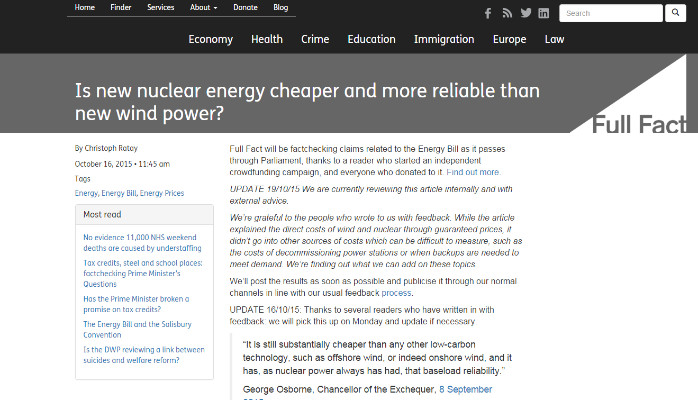
    So far, so good. The project met – and exceeded – its target, and Full Fact were duly commissioned to undertake the work.

    Naturally I was extremely interested in seeing the outcome of the checks, so when the first update was posted, I was one of the first to read the results.

    Imagine my surprise and consternation to find that – apparently – nuclear is more reliable than wind.

    What Full Fact had done is taken the load factor for the two technologies and equated that to reliability. Patent nonsense; according to this approach solar energy is incredibly unreliable because the sun doesn’t shine in the night. Perhaps Full Fact assume there’s only a 50/50 chance it’s going to come back up again in the morning!

    It was a rookie error, and one I was happy to correct. So, following the guidance on the website, I emailed the team, and then tweeted with some information about Portfolio Theory which should have helped them understand their error.

    That was last Friday.

    To my great disappointment, the erroneous information is still up on the website despite correspondence to Full Fact from myself and a number of other individuals and organisations.

    Rather than note that there *might* be an issue with their conclusion and withdraw the section from the website, their only communication to me has been that they’re internally reviewing the statement.

    And all the while, people clicking on the page are blithely taking at face value the ‘fact’ that nuclear is a reliable choice, and that wind just lets us down time after time.

    It’s a terrible indictment of an industry which now generates more than 10% of the UK’s electricity, and does so reliably and incredibly cost-effectively.

    The naivety of Full Fact in allowing this slur to stand – particularly when it’s been pointed out by numerous sources – is astonishing. 

    The question stands; who fact-checks the fact-checker, and are they even listening?

    Update 28th October 2015

    It seems that Full Fact are at it again – this time on popularity of wind against other energy types. This time they‘ve taken a single Survation survey of 2013 to discuss the popularity of wind *against other renewables*.

    Two problems with this; firstly, their data source is crap. Why not use DECC data which publishes independent statistics on exactly this topic each quarter?

    (My mistake – they had used DECC data at the end of the article, sorry.)

    Secondly they’re only comparing renewables with each other. We know that renewables are insanely popular compared with fossil fuel and nuclear technologies, so it’s no surprise that onshore wind isn’t top. So why restrict the discussion to renewables alone given the title “What do Brits think about wind farms”.

    Perhaps Full Fact Partial Opinion have taken money from Alison Hood to carry out the work, but have a higher calling to support nuclear and fossil fuel companies?!


  • An energy policy for future generations?

    An energy policy for future generations?

    The general election of 7th May produced a result which was equally unexpected and unwelcomed by most in the UK.

    The surprise of the night was not that an unwelcome party was to form a new government – only once since 1931 has a government won more than 50% of the popular vote – but that it was the Conservatives who had won an outright majority.

    On the face of it, this could have been great news for the renewable energy sector. After all, this was the party led by David Cameron of wind turbine, husky and ‘greenest government ever’ fame.

    David Cameron, who used to ‘hug a husky’

    However, there were some ill tidings amongst the spin, not least the desire to ‘get rid of the green crap’, and the manifesto commitment to getting rid of new subsidies for onshore wind, the cheapest form of renewable electricity generation.

     It didn’t take long for the hostilities to commence.

    Within the first few weeks the government was consulting early closure of the Renewable Obligation for onshore wind, medium-scale solar, biomass co-firing and on the ability of projects to seek pre-accreditation for feed-in-tariff projects.

    Shortly afterwards there was the end of the Green Deal, the end of lower taxes for low-emission vehicles, the scrapping of the zero carbon homes plan  and the requirement for renewable electricity generators to pay the Climate Change Levy, a breathtakingly brazen counter-logical decision.

    In the face of this onslaught against one of the UK’s fastest-growing sectors, investors did what they’ve always done when faced with uncertainty; considered their choices and started to look elsewhere.

    Wales; a refuge from the storm?

    Wales hasn’t escaped the economic vandalism. Although planning and environmental permitting are devolved, the UK-controlled renewable energy subsidy is pivotal to the viability of projects in Wales.

     Unsurprisingly, projects are starting to be pulled. With around 40p of every pound spent on onshore wind projects coming to Wales, and the potential investment running to billions, the impact on direct investment and supply chains is colossal.

     Sadly, Wales-based companies, including those in the rural areas that the Conservatives profess to cherish, are also struggling to cope with the uncertainty.

     Dulas, one of Wales’ best-loved renewable energy companies, recently announced that jobs were at risk in Machynlleth, compounding the earlier announcement that Mabey Bridge of Chepstow was to close.

    Community energy projects are in disarray as the certainty they enjoyed from pre-accreditation for the feed-in-tariff disappears in front of their eyes.

     However, there are some ways in which the Welsh Government has acted to protect the interests of the people of Wales.

    Firstly, planning policy is devolved to Wales. So whereas the UK government has effectively banned onshore wind in England, the Planning Act for Wales will enable Welsh Government to determine decisions for projects between 25 MW and 50 MW in size, and also to take decisions away from local authorities which are seen to be performing poorly.

    Secondly the blanket hostility to the renewable energy sector from Conservative Ministers at Westminster is contrasted starkly by the fulsome support from Carl Sargeant, our Minister for Natural Resources. This contrast is not restricted to onshore wind; whilst the UK Government rushes to develop the shale gas resource (fracking) in England, it is likely to face a moratorium in Wales.

    Tweets from Carl Sargeant, showing leadership against vacuous UK Government policy 

    Devolution has required Welsh Ministers to embrace sustainable development, and the Bills and Acts for Active Travel, Future Generations and Environment are clear indicators of a Wales which is attempting to genuinely grapple with the complex issues which surround sustainability.

    And whilst we have undoubtedly scored some spectacular own-goals – the most obvious of which was the token improvement in energy efficiency in the last review of building regulations – the general direction of travel is hugely encouraging.

     Given that we will eventually see the devolution of energy policy to Wales with the passage of the next Wales Act, the likelihood is that the medium-term outlook for the sustainable energy sector in Wales will continue to improve.

    Towards 2016

    In June I predicted that the early activity from Amber Rudd would be pushing the business community of Wales and Scotland in a nationalist direction. I stand by that analysis, and conversation with people working in the sector reveals that they regard Wales and Scotland as potentially ‘safe havens’ from the whirlwind being created in Westminster.

    As we move closer to the elections in Wales, we will start to see whether the political parties of Wales step up in support of the sustainable energy sector. Early indications are encouraging with Plaid stating their commitment to a target of 100% renewable electricity in Wales by 2035, should they be elected to form the Welsh Government in 2016.

    This will – hopefully – start a sustainability ‘arms race’, in which the parties of Wales will be striving to produce a narrative for the 2016 election which appeals to one of the principal interests of the citizens of Wales, namely living within the limits of our environment.

    The National Conversation highlighted the importance of the environment to Wales 

    The UK Government’s energy policy is not worthy of the name. As the Financial Times stated recently, “sweeping away much of what the prime minister allegedly called ‘green crap’ is not on its own an energy policy”.

     Devolution is good for the people of Wales. Our renewable energy sector will be more productive and employ people with greater certainty than England. We will hopefully see improvements in energy efficiency regulation which upskill our workers and construction companies, and allow us to export more of our goods and services. And we anticipate much more activity in the fast-moving ‘smart energy’ sector, which have the potential to bring a whole new generation of businesses and entrepreneurs to Wales.

     The paths of Wales and England are slowly diverging. For the sake of the renewable energy sector, for the sake of sustainability, and for the sake of future generations, that is something to be warmly welcomed.

  • We owe each other a renewable future

    We owe each other a renewable future

    The Nuclear Decommissioning Authority has today announced its draft budget for 2015/16. The sum will be £3.31bn, of which £2.1bn comes from the public sector. That’s public money being used to subsidise electricity which has already been used.

    The cost for subsidising electricity via the Renewable Obligation, is around £2bn, with another 1/2 billion for the FIT, and – since we’re comparing – the latest estimates for fossil fuel support are around £4bn.

    All elements of our energy system attract subsidy. What I find distasteful is that the users of nuclear electricity over the last 60 years have handed the cost of dealing with the waste to the citizens of today. Our leaders of yesteryear created a large unfunded moral hazard for future generations. The waste issue remains one of the biggest problems faced by the nuclear industry in their programme for new-build in the 21st century.

    The decommissioning figures don’t include any aspect of subsidy for electricity production, or the credit guarantees which have been offered to nuclear projects in the UK. In the future, nuclear will benefit from a very generous subsidy of its own for electricity production, via a 35-year, index-linked Contract for Difference agreement, which will see UK taxpayers making generous contributions to state-owned French and Chinese utilities.

    The renewable choice

    Renewable energy continues to tumble in cost – the industry expects solar energy to be subsidy-free around the turn of the decade, and onshore wind is projected to reduce its cost by another 10% in ten years. That’s in stark contrast to the nuclear industry which has a history bedevilled by cost and time overruns in its latest projects (Finland and France).

    Renewable energy isn’t a panacea to our energy needs – at least not yet. Although renewables have highly predictable output, we’re not able to store significant amounts of electricity on a daily or seasonal basis. That limits the ability of renewables to become the dominant part of our electricity economy, and points to the need for a far greater effort to incentivise R&D in energy storage technologies, and to commercialise those that currently exist.

    Expertise in the energy storage and smart energy sectors would serve the UK well in the future, providing us with the opportunity to export goods and services over future decades. And yes, maybe some of those customers might be French and Chinese!

    Our energy future, and our hard-earned cash as taxpayers is best served by a massive focus on energy efficiency, increased deployment of existing technologies, and a huge effort in R&D on energy storage and smart energy systems. Let’s run our existing nuclear fleet as hard and as long as it’s safe to do so, and then spend our money where it delivers best for our children and grandchildren; a renewable future.