After seven amazing years running Afallen with three brilliant colleagues, I am stepping back into the world of academia. It’s with real pleasure that I’m starting my new job today as Head of Climate Action at Cardiff Met University. The university has rightly been recognised for its pioneering work on carbon reduction and sustainability. It clearly also has huge ambitions that go beyond meeting required targets on carbon reduction that extend into demonstrating practical solutions for the benefit of the whole sector.
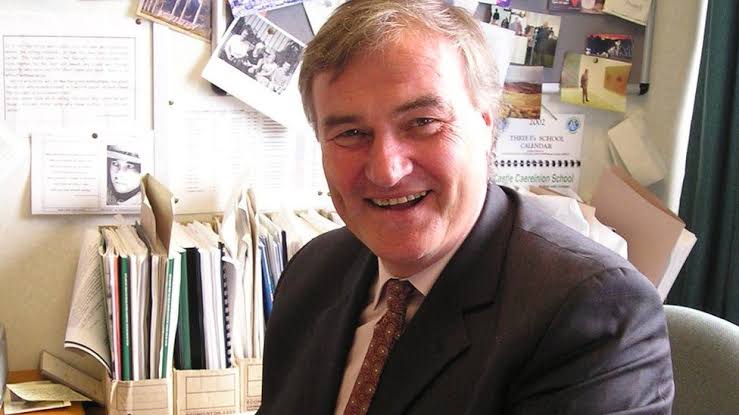
Me arriving on Day 1.
Higher education has a powerful role to play, not just in reducing the emissions of the education sector, but also in showing leadership at the scale of large estates, and providing learning opportunities for thousands of tomorrow’s leaders. I hope to be able to play a role in helping shape that side of things too – particularly relevant given CMet’s acknowledged expertise in training the teachers of tomorrow.
Improvements in how we account for and manage our carbon impact can’t be made solely through technical means. Climate change is an engineering and scientific challenge; but it is also a human one, which requires thought about narrative, values and social justice. I intend bringing my experiences with NICW to CMet, and to help implement many of the approaches that we have recommended at NICW, particularly in our most recent report on community engagement and climate adaptation (worth a read if you haven’t yet!)
One of the speakers at the launch event of NICW’s report on community engagement and climate adaptation.
Ahead of starting at CMet I’d like to thank my new colleagues, in advance, for your patience and support while I get to grips with the new role. I am also asking for the same in anticipation of the mistakes I’ll make along the way, but unapologetically, as in “I know I will be going to make mistakes but that’s ok”. As I keep telling my children, without making mistakes, we cannot learn. The idea is to learn from our mistakes and then amend or discard what hasn’t worked, doubling down on things that seem to be doing well. The urgency of the climate and nature emergencies requires that we move rapidly from ‘business as usual’ towards new ways of doing things, which suggests change in pretty much every area of society, and sooner rather than later.
But urgency has to be balanced with agency. I’m a believer in people knowing their own areas of work; that decisions should be taken as closely as possible to the level of impact (subsidiarity). In NICW’s work with communities we have seen that there is far too little trust and understanding of communities by statutory bodies. In bringing that understanding to my work at Cardiff Met, I’d like my actions to empower staff and students with the ability to make tangible differences to their own lives and local environments.
Cardiff Met has shown purpose and ambition in their journey towards a zero carbon institution that helps others reach their full potential; I’m delighted to be able to become a part of that story, building towards a Wales that enables thriving communities within a flourishing natural environment.
Ditching Android: Two months daily driving Linux as my only Mobile OS
Last year I wrote two blog posts about #LinuxMobile; the first was a conceptual piece about how linux mobile could be a safer mobile technology for children. The second was my experience using Ubuntu Touch (UBports) for a week.
Hold on to your hats; I’ve leveled up. I have now been using mobile linux for two months as my daily driver (i.e. my main mobile device). This blog post is to share my experiences with linux on mobile to help others decide if it’s right for them (tldr; likely not).
Why now?
I have been an enthusiastic proponent of open source and linux since the early days of Ubuntu and Inkscape which blew my mind about the functionality available in free software. I was already a convert by 2005 – although I confess there were some very rough edges, particularly to Ubuntu at the time (ndiswrapper to enable wifi was a particular memory).
I was an unashamed fanboy of Google from 2004, being an early adopter of gmail and then google drive. In 2006 we were using google docs to collaborate live at the (long defunct) Mid Wales Energy Agency, functionality that still doesn’t seem to have made it into every organisation I come across nearly twenty years later 🙄.
So it was no surprise that when google launched the Android operating system I was, again, an early adopter choosing more or less the only option at the time, a HTC Hero.
I kept buying Android because – well I loved it, being an open source project – and what was the alternative? Closed source (and expensive) Apple? I mean, Google’s motto was ‘Don’t be evil’ – what could be more unambiguous? I guess time proved me to be hopelessly naive on that one.
This understanding led me to ditch Instagram (2019) and Twitter (2020) and eventually google’s version of Android when I moved to GrapheneOS. However, even de-googled versions of Android still depend to a significant extent on google services, depending on what apps you need to use. Which is where Linux on Mobile comes in!
Mobile Linux – software and hardware
I wrote about mobile linux in 2024 in my blog post on the suitability of the software for children. In the 15 months since that blog post the software has improved markedly. To take one example, in April last year PostmarketOS was not quite at the same version of linux as desktop. Now both mobile and desktop are more or less using the most up to date versions.
The wider ecosystem is maturing too; witness Flathub – the brilliant online software repository for linux apps – having a special category for mobile apps that has only been existence within 2025.
New entrants into the hardware world include Furi Labs (with a live product), Liberux that recently launched a crowdfunder for their NEXX phone that achieved 10% of it’s £1.25m goal, and the DawnDrums DivineD phone. These are on top of existing manufacturers that were operational a year ago, such as the Librem 5 by Purism and the Pine64 set of products.t
Apart from the bespoke products listed above, the list of android phones that can be repurposed for linux grows monthly. Although advances are being made by a range of development teams including Mobian and Ubuntu Touch, the most interesting development for me is being undertaken by PostmarketOS which has a list of many compatible devices, helpfully listed by their launch date. PostmarketOS has a variety of flavours to try such as Phosh, KDE Plasma Mobile, Sxmo or Gnome.
I like the interface, and I already had an old OnePlus 6 – one of the best-supported devices – so that’s what I decided to use as my daily driver.
Indeed, several attendees at the event told me on the evening that they would definitely be trying out linux on their mobile devices. Target achieved!
Using mobile linux as my daily driver has introduced significant friction into my life. My OnePlus 6 cannot receive phone calls due to some terrible audio problems (presumably hardware as the audio is listed as working on the website). This means that I am using a second linux phone, a OnePlus Nord N100 running Ubuntu Touch, as my ‘phone call and text’ device, and also as a mobile hotspot for my OnePlus 6 for when I need internet out and about.
Sadly with Android locking down the security of banking apps, Waydroid is no longer a viable method to use some mission-critical things like banks or the gov.uk ID check. And due to GPS not working well/rapidly without the Android functionality, navigation apps aren’t brilliant on linux phones either. Which means that I need a third ‘burner’ Android phone specifically for these very few use cases. Luckily this sort of phone is readily available and cheap second hand on ebay.
Still; I generally find myself out and about with at least two phones, and the third at home, unless I’m going away for a few days in which case I need all three. Hence the image of the goblin with the three phones.
I’m holding out for a relatively recent Android phone to become functional which will enable me to retire my two existing linux phones.
My experience so far
Two months in, how is it going? Well – my use case is fairly straightforward. I listen to a lot of podcasts at 1.75x speed, and I like to listen to epub books read by TTS engines. Both these needs were perfectly met on my Pixel 6 running GrapheneOs. They are not at all perfectly met on my OnePlus 6, but I guess they achieve Minimum Viable Product status.
For example, the Podcasts app (by far the best one I’ve tried) does allow variable playback but it needs setting manually each time rather than being a global setting, and also doesn’t auto delete podcasts after listening.
For books, my epub software of choice, Foliate, works perfectly for reading, but for TTS is a bit clunky. I can only get it to use the robot voice and it doesn’t remember my place between phone shut-downs, starting always at the start of a chapter. This cannot be changed manually either, so if the phone shuts down (which it occasionally does randomly) you have no choice but to listen to the book from the start of (any) chapter, often hearing again something you just listened to earlier that day.
Bluetooth generally is ok, but sometimes drops for no apparent reason. A minor frustration but something I can live with.
Years ago I used to play quite a few games on Android, but that decreased to just Sudoku for the few years on GrapheneOS, and now the only game I have on my linux phone is Shattered Pixel Dungeon which works flawlessly and is excellent.
I should round off with a mention of the camera – which has just been upgraded to a very basic version that just about works albeit with poor focus and strange hues. THIS IS A HUGE ACHIEVEMENT and a massive improvement on previous where there was no camera functionality at all. This would definitely not be suitable if you want to take photos of special occasions, family events etc but I can always use my second linux phone for that.
In general I use my OnePlus 6 for approximately 90% of my activity, my OnePlus Nord 10 for 8% (calls, camera and texts) and burner Android for 2%.
So…why bother?
This is the most obvious question. Deliberately introducing friction into your daily life must surely rank as an act of stupidity? Certainly some people close to me think exactly that 🤣
Here’s a few responses.
Something I haven’t yet mentioned is that I don’t like being tracked and having my data harvested by big tech. This is probably not something that is in your mind regardless of what mobile system you use. But, like the air you breathe, it’s there. Everyone around you is being tracked. Their every interaction is being meticulously logged and sold to hundreds of companies and states globally. Stepping out of that ecosystem has its own value, even if it feels more philosophical than practical for now.
If I’m honest, I love being at the cutting edge of technological change. I feel like I am probably the only person in Wales daily driving linux at the moment. The regular updates are great to see. I feel as though I’m part of an important journey to a more free and open future.
If you’ve read my post about linux phones and children, you’ll understand that I think there are potential benefits for linux mobile for children in particular. Me using mobile linux will enable me to be in the best possible place to support my own children when it comes to them getting their first smart phones.
Finally…maybe friction is the point. If we (collectively) are spending too much time on mobile devices, and not enough in nature or with friends and family, having a phone that doesn’t constantly demand your attention is a positive and practical step towards a rebalanced life.
Summing up
Even though using mobile linux has introduced additional friction into my life, I’m sticking with it. I feel as though I’m part of a tiny global experiment, a rebellion like in Star Wars against the might of the Empire. The rate of development is astonishing, and I am convinced that many of the friction points will be smoothed off or eliminated completely within the next year or so. And when that happens, I want to be able to help other people sign off from the surveillance economy and become liberated, happy and healthy mobile linux users!
List of current apps
I thought it might be interesting to others to know what apps I have on my linux mobile. I’ve added links if they are not automatically provided in the installation process.
Web apps – for creating PWAs for sites of interest. I use mine for yr.no, ebay or other regularly vistited sites that I don’t want to have to launch firefox and browse for
Acknowledgements
I offer my deep and sincere thanks to everybody who has contributed to or supported open source software. Everything from the kernel to individual apps is a labour of love and generosity to humanity, and I am humbled by historic and ongoing efforts to make software accessible to all, no matter background or circumstance.
Edits
Altered one of the ‘why bother’ entries to focus on friction being helpful for reducing the draw of electronic devices, rather than the incentive to keep up to date with development of linux mobile.
Becoming a Fellow is not simply a recognition of experience. It is also a call to continued leadership, integrity, and impact. As I reflect on what this means to me personally and professionally, I’m struck by how closely my values align with those of ICE: sustainability, public benefit, technical excellence, and ethical leadership.
This alignment feels especially timely given the ICE’s recent blog post reflecting on the 2025 Climate Change Committee (CCC) Progress Report. The post highlights five key takeaways, all of which underscore the urgent need for civil engineers to step forward with clarity, courage, and conviction.
From infrastructure adaptation to the critical importance of systems thinking, the ICE’s reflections on the 2025 CCC Progress Report make one thing clear: we must move beyond technical delivery to embrace ethical stewardship of both the built and natural environments. This is a message that resonates deeply with me.
As a newly appointed Fellow, I see part of my role as championing and supporting the Institution’s vision. But that also means being willing to challenge, constructively, when something vital is missing from the conversation.
For example, while the ICE rightly highlights electric vehicles in its response to the CCC report, there is a noticeable absence of any reference to active travel or public transport. In a truly integrated and sustainable infrastructure future, these modes are not peripheral; they are central. I believe this is a critical oversight. I hope that my voice as a Fellow will help the ICE prioritise nature and the environment within discussions about engineering and social good!
In my own practice, I have always held that engineering is not solely about building, but also about connecting: people to places, communities to opportunity, and today’s choices to tomorrow’s consequences. The responsibility to embed resilience, equity, and coherence into our infrastructure systems is one I carry with deep conviction.
Fellowship: A Platform to Contribute More
Earning this Fellowship isn’t the end of a journey of learning and professional dedication; for me it’s a platform to mentor, to advocate, to collaborate, and to help shape the profession’s response to some of the most complex systemic challenges of our time.
As ICE rightly emphasises in their post, infrastructure must not only be decarbonised, it must be future-proofed, people-centred, and guided by long-term thinking. These are the very themes I’ve worked to integrate into my own approach, whether through innovative project design, stakeholder engagement, or cross-sector collaboration.
Looking Ahead
I’m proud to stand among peers who are not only technically accomplished but also committed to societal impact. The ICE Fellowship is both an honour and a responsibility that I embrace with humility and determination.
To those in our profession who are striving to align impact with integrity, and engineering with empathy: let’s continue this vital work together. There has never been a more important time for civil engineers to lead with vision and values.
Earlier this year (2024) I wrote an article about my belief in linux phones as a partial solution to the multiple distractions and negative influences being piped directly into childrens’ brains by their use of mobile phones, and particularly the use of social media, at a young age.
If my own children are to use linux phones, I have to dogfood it for myself. Partly to show leadership, partly for reasons of trouble-shooting.
For the last week or so I have been using Ubuntu Touch (by UBports) on a OnePlus Nord N10 5g, and then a Fairphone 3 (because I lost my OnePlus!) to understand whether I could use it as my daily phone, without having my GrapheneOS Android in close proximity. (Note – if you’re not yet ready to leave Android but you want to take the first step in mobile privacy, GrapheneOS is a brilliant first step if you have a Google Pixel phone).
TLDR: I’m not yet ready to use Ubuntu Touch as my daily driver. Read on to find out why.
Caveats
I have a limited amount of time to be able to properly dig into different alternatives to various apps. I have gone as far as trying flatpak versions of different software packages in order to get things to work. However it is likely that there are solutions to some (most?) of the problems I encountered. I am grateful for any suggestions for alternatives that might work!
Why Ubuntu Touch?
There are plenty of people who will tell you that Ubuntu Touch isn’t ‘real’ linux because it’s based on an Android ‘layer’ that enables it to use the hardware.
That’s fine; I’m less interested in purity than usability. I love 💗💗 the work being done on PostmarketOS and other pure linux systems, and I can’t wait until they are able to work with the drivers on a wider array of phones. But until then one of my ‘show stopper’ use cases is taking photos of my family, and in that case Ubuntu Touch is probably the best choice.
Ubuntu Touch can also run Android apps via Waydroid (this is also the case with most linux mobile systems), which helps make the transition to a linux device more manageable.
Ubuntu Touch also tends to be available on more modern phones; if I’m going to be moving from Android, I want my phone to have realtively good specs.
Installation
Most linux-enabled phones are on the old side, and I want something newer both for myself and for my kids when they are old enough to need a phone of their own
I looked at the websites to find the most ‘modern’ linux-compatible phone I could (as of June 2024) and it appeared to be the Nord 10 5g. I bought one for £120 on ebay.
Ubuntu Touch (Ubports) was the most likely solution, even though it’s not ‘pure’ linux (it’s a modified layer sitting on top of the Android driver set). This is because the disadvantage of sticking close to the android code base (more on that later) is mitigated by the good access to the camera. And having a good quality, working camera, is an absolute show-stopper for me
Running the UBPorts installer is generally a piece of cake, but in this instance it failed; my first attempt resulted in a soft bricked phone. I hadn’t read the instructions, which specified that it should be downgraded.
That set me back a few months as all my computers are linux. The downgrade tool provided by OnePlus only works on Windows.
Lucky for me I had a Fairphone 3 as backup (£60 on ebay) as I have since lost the Nord 10! But nonetheless I learned some useful lessons along the way, not least to read the documentation before trying to install.
Installing Ubuntu Touch on the Fairphone is very straightforward. Connect the phone via USB, run the installer and you’re away. Super-simple.
On OnePlus Nord 10, you have to downgrade the software using the MSM tool you then just connect the phone via USB and run the installer as for the Fairphone.
Things that just worked
Here’s a list of things that worked mostly just like you expect.
WhatsApp Web (using a burner Android phone as the ‘host’)
Mastodon
In other words, most of the basic functionality that you would expect from a simple smart device is functional.
Things that worked via Waydroid
Some functionality is not available natively to Ubuntu Touch and needs to be installed through Waydroid. This has a delayed startup compared with a native app; which is usually not a big problem. These apps include:
One of my banking apps (Nationwide) – note several other banks did not work via Waydroid
I struggled a bit with a suitable 2FA app. Initially I used the 2FA Manager app; however I wasn’t able to use either the camera or manual login. Happily Authenticator NG worked perfectly.
WhatsApp
I also wanted a work-around for WhatsApp. I refuse to install the app on any device, and anyway there’s no app for it on Linux phones. So the solution is to use a burner Android phone (use an old or super-cheap ebay one) as the main account, and then login via WhatsApp Web. The formatting via the app worked much better than the browser version in my case.
Contacts
I couldn’t figure out an easy way to sync my contacts with Nextcloud (I have struggled with WebDav), so I manually exported from my ‘main’ phone and imported them which worked fine.
Things that haven’t worked out
Sadly there are some things that either haven’t worked at all, or are only partially successful.
GPS
Navigation is one issue; Android phones are apparently bundled with drivers and software to make GPS connections very fast. This is not the case with Linux installations, which are slower to identify location. Whilst in principle the various mapping tools, such as Pure Maps or uNav, work perfectly, they are dependent on the GPS location in the first place.
If you are patient this does not present a problem. If not it might be an issue. GPS fix is affected by density of nearby buildings etc, so is likely to be a bigger problem in towns and cities than the countryside.
Banking apps
I have a business bank account that just didn’t work; this is a problem, as the app is generally needed to confirm purchasese, payments etc. I guess this is something that could be done on the burner phone, but it is less convenient. There is likely no way around the issue as the banks have security that is tied to the Android operating system.
Password manager
I didn’t expect a password manager to be a problem, but I couldn’t get a work-around for Bitwarden; the web vault refused to open, and there appear to be no viable locally installed password managers.
Podcasts
I’m a big listener to podcasts, and there is a perfectly usable podcast player, PodPhoenix. However I like to listen at 1.6x speed, and there is no capacity to modulate the listening speed. This would mean I would have to miss out on a substantial number of podcasts.
E-reader
When I run out of podcasts, I like to listen to books being ‘read’ (text to speech). This is possible on GrapheneOS via Librera FD but I haven’t found anything similar yet for UT.
Design choices
While I’m on the subject of Ubuntu Touch, I think it’s worth mentioning that the notifications/top pull-down bar is not as intuitive or helpful as the standard Android or PostmarketOS one. Sometimes you have to search around a bit to find (for example) the wifi hotspot or torch functions. Although not a showstopper, there’s probably a reason why other systems have gone with the ‘most used’ apps in an easily reachable drag-down area.
Other than that, the swiping system and pinning of apps works effectively.
Conclusion
As it stands, I am having to bring along my existing GrapheneOS device as well as the Ubuntu Touch for my daily driver, predominantly to listen to podcasts at variable speed. Also quality of life stuff like the banking apps (though less of a showstopper).
Having two phones with me is probably the reason I lost my first Ubuntu Touch so I’m going to revert to GrapheneOS for now, and maintain a strong interest in the further development of Ubuntu Touch, PostmarketOS and other mobile linux systems.
However, the reasons for me reverting the GrapheneOS phone are not showstoppers for my own children, and I am confident that when it’s time for me to consider what phone they should have, I will feel reasonably happy with mobile linux as an ethical and practical choice.
Edits
Added the lack of an E-reader that can provide TTS functionality
In June 2024 Welsh Government launched a ‘call for information‘ on what is needed to make technology more friendly to Cymraeg.
I produced a response to highlight the power of open source in enabling low-cost, high quality and ‘translation-friendly’ services. I post the response in full below.
The value of Free and Open Source Software (FOSS) to health and well-being in Wales is so profound that it should be supported through a fund or equivalent of approximately 0.001% of the NHS budget
Public bodies in Wales should be required to use a FOSS equivalent (where one exists) of any existing proprietary social media platform, and to contribute to Welsh translations of the platforms
Philosophy
Technology is never agnostic. The deployment of technological tools depends strongly on the philosophy of those who created it. My response to this call for information is therefore predicated on the standpoint that open source solutions are generally preferable to commercial and proprietary alternatives.
Open source (also known as FOSS – Free and Open Source Software) has four freedoms:
Freedom 0: The freedom to run the software as you wish, for any purpose.
Freedom 1: The freedom to study how the software works, and change it so it does your computing as you wish
Freedom 2: The freedom to redistribute copies so you can help others
Freedom 3: The freedom to distribute copies of your modified versions to others. By doing this you can give the whole community a chance to benefit from your changes.
The beauty of FOSS to Wales is:
Using FOSS eliminates the leakage of money from Wales for licencing costs for using proprietary software
FOSS usually makes it very easy to translate, greatly reducing barriers to adoption for people who would like to use the Welsh language.
Using FOSS can help upskill people within Wales (see freedoms 1 and 2).
Using and supporting FOSS directly helps achieve Wales’ future generations goal of ‘Globally Responsible’, because any improvements that are supported or produced from participants, volunteers or donors in Wales, are freely available for use or adoption by anybody globally, reducing the barriers to participation by the poorest in society (in Wales this supports the socio-economic duty)
In the European context, Wales is a poor country within a poor unitary state, particularly if London is excluded. Issues of ownership and licensing are very important in this context. The use of proprietary software effectively means that the people of Wales are paying people elsewhere so that we can de-skill ourselves.
In February 2022 I produced a White Paper entitled: “Why Wales should embrace free and open source software”. In it I made the case for open source against several Welsh Government objectives in the Digital Strategy for Wales. FOSS directly supports the following components:
Digital inclusion – creating digital public goods
Digital skills – widening participation in learning, and participation in communities of technology and interest
Digital economy – for some sectors, savings of more than 80% have been achieved through the use of FOSS
The use of the Welsh language produces numerous benefits for the individual, and still more for the community at large. Some of the individual benefits include:
Improved health outcomes
Improved career prospects
Increased performance in learning additional languages
Some of the benefits of using Cymraeg, all of which are evidence by peer-reviewed literature
The health, educational and economic benefits are so profound that I believe the case should be made to divert a tiny proportion (say 0.001%) of the budget for the NHS to establish or fund an independent organisation aimed at improving understanding and adoption of FOSS in Wales.
Cymraeg and communication technologies
Welsh public institutions have been ‘captured’ by the early proprietary communication platforms to the extent that most use X/Twitter, LinkedIn, Instagram or other platforms without a thought as to the rationale, or the case for using alternatives that better support the Welsh language.
The use of proprietary platforms indirectly enriches far-right voices, and certainly leads to a leakage of money and skill to (usually) America-based organisations through advertising and data harvesting.
The proprietary platforms are not generally responsive to requests for making their interfaces multi-lingual, in direct contrast to their FOSS equivalents.
In order to properly implement the requirements of the Well-being of Future Generations Act, as well as the Welsh Language Act, public bodies in Wales should therefore be required to use FOSS social media platforms (where they exist) in addition to, or as a replacement for, their existing use of proprietary social media platforms.
This would give the opportunity for them to also contribute to the Welsh language translations of these platforms, making them more suitable for Welsh-language users.
I first met George when I was a first year undergraduate student at Lancaster University. I attended supervisions with him, in the company of my fellow student Graeme Plenderleith (we are still friends to this day!).
“Someone possessing extraordinary intelligence or skill; especially somebody who has demonstrated this by a creative or original work in science, music, art etc.”
He certainly took no prisoners with his students. I remember the first session we had with him. His room was a chaotic mess of papers and books, and after we’d found ourselves somewhere to sit he asked us questions about the physics we were studying. When I responded to one of his questions with a timid (and wholly inadequate) response, his retort was “like fuck it is”.
I was fairly shocked by that – but George went on to kindly explain to both me and Graeme the basis of our misunderstanding. During the course of that year, he systematically helped break down and rebuild our understanding of the basics of physics, and did so in a way that was somehow warm and patient, even as it was highly intolerant of any lack of intellectual rigour.
When I returned to Lancaster in the 2000’s it was as a post-doc, working in the low-temperature laboratory where George was still very active. It was there that I got interested in his ability to produce incredible graphics to help elucidate the most complex physics properties at low temperatures in ways that were easy to interpret.
My interest in the design side was almost as great as my interest in physics, and when I left the lab to begin a career in renewable energy, I continued to tinker with graphic design. Without access to the adobe software packages, I eventually stumbled upon Inkscape, an open source alternative. And so began my love affair with open source software, a passion which continues today.
I attended the funeral on 12 August 2024 remotely. Given his international notoriety in academia I suspect that the online audience was many multiples of the ‘in person’ attendees.
There were many details about his life recounted by family members that helped fill in the parts that would have likely been uninteresting to me as a teenager, but which now add the richness and colour that bring wonder to our lives. I was also extremely touched by the eulogies, including an emotional tribute one by my ex-colleague, Richard Haley.
I wept during the funeral, and I have continued to think a lot about George in the days since. He was certainly influential on me, but I can’t attribute my sadness solely to his passing (no offence, George!). He was a thoughtful, outspoken, funny and kind man. Like thousands of others who die every day. His life touched mine in a small but significant way. I think my sadness is at least a reflection of mortality in general, and that of me and the people I care about in particular.
I turned 50 this year. After the briefest of skinny-dips in the Gower to celebrate, I put my arm around my twin brother, and said that although we wouldn’t see another 50 together I was so very proud and happy to have spent the first 50 in his company.
I think that my sadness that George has died is a sadness for almost everybody that has been a part of my life, and that I will miss when they’re gone. People in Lancaster, Machynlleth, Bristol, Northumberland and Denmark. People who aren’t close family, that it’s not practical to see often or even regularly, but that gave my life meaning and love.
My parents’ generation is now becoming elderly. It feels as though there’s a slow-motion passing of the baton going on. I was nearly the same age now, as George was when we first met. In the way that George helped me as that first year student, I think it’s my duty now to help young people through the challenges they face, and to try to advance sustainability to the best of my ability through the rest of my career. Yes, and to have fun, lots of it. Whatever else George was; father, husband, genius physicist, grandfather, he was a funny, lovely guy.
I was not George’s friend but I miss him, and I miss what he represented. George, your legacy will continue to inspire me for years to come.
In this age of the hyper-now, of social media, celebrity and status, of notifications and updates; his passing is a reminder that life is not about how we present ourselves to the world, but how we can use our talents and kindness to make it a better place.
I have two children in primary school. They live in a world where mobile phones, and specifically smartphones, are ubiquitous. And …. that’s not necessarily a bad thing. When used ‘smartly’, mobile phones are valuable sources of information, entertainment, organisation and communication. However there are downsides, as I describe later.
Like many parents, I have considered the inevitability of my children having phones of their own. Like most parents, I have grave reservations about them having unfettered access to the whole panoply of social media and internet. How to strike the right balance between maximising the ‘good’ that can come from use of mobile phones; to limiting the ‘bad’?
Read on. This is my journey as well as yours.
Caveats
This blog post is predicated on the negative impacts of ‘excessive’ use of social media in children and young people. In this article I’ll use ‘young people’ as a catch-all for anybody below the age of 16. I’ll use ‘guardians’ to talk about anybody who has legal responsibility for young people, which includes parents, guardians and carers.
Although this blog post is focused on how to mitigate the harm to young people from unfettered access to social media via mobile devices, there is potential harm to people of all ages from social media. It is precisely because I have become aware of the harm from mainstream platforms such as Instagram and Twitter that I limit my social media to open source equivalents such as Mastodon and Pixelfed (with the exception of LinkedIn for which no viable open source alternative currently exists)
The Linux phone ecosystem is developing at a blistering pace, even though it is predominantly volunteer-driven. This is largely due to being able to use the existing linux codebase, adapted for small touchscreen devices. This means that the current state of the art is likely to be significantly improved on a monthly basis from the date of publication of this post
The impacts of social media on young people
The science that underpins our understanding of the impacts of social media on young people is rapidly evolving, and contested. However there appear to be five main negative impacts of social media on young people:
A depletion of time spent with people in the ‘real’ world (social deprivation)
Disturbance to sleep
Attention overload
Addiction to the dopamine ‘hit’ of notifications etc
Mental health impacts arising from viewing unrealistic body or lifestyle ‘visions’
There are numerous examples of research and policy on this topic. I list several below:
There is a general agreement that children should not access social media, possibly with an implicit recognition about the risks associated with social media. However there is considerable disparity about when is a ‘safe’ age to participate:
Of course, it’s one thing to suggest an age limit for using social media. It’s quite another to be able to ‘police’ it effectively.
Note that the evidence of harm on young people from using social media is not one-way. There are many studies that suggest there are positive outcomes. Positive outcomes can include obtaining positive feedback from peers or others online when posting information.
Simple mind map attempting to summarise the relationship between phone use and
Why can’t/won’t existing phones act?
The two dominant phone ecosystems are Android (Google’s mobile phone platform) and iPhone (Apple’s mobile platform). Both these platforms are inherently unsuited for tackling issues relating to children’s health and social media, because:
They derive significant revenue from their own services (e.g. YouTube, various Apple products)
They harvest data from users that can be sold to third parties, or used to directly target advertising (known as ‘advert personalisation’)
Phones offer the opportunity to present Google as the default search engine, cementing Google’s dominance in the search/advertising space. Apple is also a beneficiary of this, receiving large annual payments to have Google as the default search engine on the iPhone platform.
If Apple and Google restrict the ability of children to access social media accounts, they reduce their own income, and they reduce the number of years which people interact with advertising via social media platforms.
Companies have a legal obligation to maximise their return to shareholders. Their legal obligations to children are far less clear. It seems likely that social media companies will therefore drag their heels on making their platforms safer, if there is a resultant reduction in their income.
Society at large, and guardians in particular, have a few choices they can make in response to understanding the potential harm from young people accessing social media.
Do nothing and hope that young people will be ok (business as usual)
Petition social media companies to be better at protecting the mental health of our young people
Improve regulation
Make different choices for young people, such as:
Allowing them a ‘dumb’ phone rather than a smartphone
Provide them with a smartphone that does not facilitate engagement with the most damaging social media platforms
Choice 1 is likely to be the default choice for most people. Even if guardians are aware of some of the risks for young people, it is hard to resist constant pressure, including peer pressure. I have great sympathy with anybody who goes down this road. No judgement here.
I judge Choice 2 as unlikely to be very effective. If any changes are made, they are likely to be the smallest necessary to satisfy public demand. This is because the mobile phone platforms answer predominantly to shareholders, and not to the public.
Choice 3 is possible, but I fear regulatory capture in the UK, and the ability of social media companies to lobby to reduce the impacts of regulation, and then to innovate their way around regulation.
Choice 4 places an unfair burden on guardians when the problem is systemic, society-wide and has ramifications way beyond individual families. Nonetheless, if we don’t have faith in social media companies to sacrifice profitability for the good of society; and if we don’t have faith in regulators or regulation to make a reasonable intervention that cannot be quickly circumvented; then we are left with Choice 4
Some people choose to not allow their children to have ‘smart phones’. This is a viable option, although potentially a difficult one for many guardians to adopt. The peer pressure on young people to have a smart phone and to participate in social media and messaging is intense. There is an undoubted consequence of ‘missing out’ (FOMO) that would be felt by the young person, although I am keen to stress to my own children the JOMO (Joy of missing out). Although this is potentially more than compensated for by improved well-being, the stress and conflict within the family unit could be challenging.
Whilst I think that the option of providing a ‘dumb’ phone to young people is a good one, I also have a philosophical reservation about it. If smart phones are so useful and valuable to adults, should we be denying their many positive uses to young people – as long as there is a plausible way to mitigate the harm?
This is the alternative I will be exploring through the rest of this blog post. It is to use a smart phone that does not facilitate access to the most damaging social media platforms which could be one way to support the call by Esther Ghey who has called for teenagers to be ‘protected from smartphones‘, proposing a ban on social media for under-16s.
This alternative already exists in the form of linux phones.
Linux phones
What is Linux?
Linux is a family of software that enables computers, phones and digital hardware to operate. It’s the software that underpins most of the digital infrastructure globally, and can be used as a highly viable (or superior!) alternative to Windows or Mac on laptops or desktop machines. I have been using linux on my laptops since 2005. Whilst it runs brilliantly on new hardware, it is also a good solution for older machines, as the hardware requirements are lower than needed by Windows or MacOS.
History of linux phones
The smartphone era began with the iPhone, and Apple continued to dominate the early years of smartphone technology.
Seeing the opportunity to grow their advertising and data harvesting operation, Google started to develop the Android operating system to compete with Apple’s iPhone.
I was a very early adopter of Android in 2010 (HTC Hero), and continued to champion Google as a more ethical (and low-cost) alternative to Apple. How naive!!
As the Android ecosystem expanded, the focus for Google appeared to be less about improving the functionality, and more about how much data could be captured from users.
People who are interested in Linux and alternatives to ‘mainstream’ phones started developing alternatives. Although this was the case from as early as the mid-2000’s, the development started in earnest in the late 2010’s driven by companies such as Pine64 and Purism.
Linux phones generally try to use the existing ‘mainstream’ Linux software and optimise it for use on mobile devices, thereby making use of an existing huge and powerful set of tools.
How do Linux phones limit exposure to social media platforms?
Although most social media platforms are available via web browsers, this form of access is inherently less addictive or distracting than the app versions.
In other words, if you are able to use only the browser version of any social media platform, your health and well-being outcomes are likely to be better than using the app versions.
Slight increase in friction to use the app, decreasing the temptation to doomscroll
Fewer terrible features
Fewer (or no) adverts
Given that there are no native apps for social media platforms for Linux phones, it follows that Linux phones are inherently safer for young people, and therefore a better choice.
Where are we now with Linux phones?
Sadly we’re not yet in a place where you can rush off to a phone shop and demand a Linux phone. Linux can be installed on a number of devices, typically older ones which have chips that can more easily be understood so that the software works on them.
The OnePlus 6 or 6T seem to be reasonably well supported, and I can personally attest for the Pinetab 2 tablet if you’re after a Linux tablet.
However there are a number of more modern devices such as Fairphone 4 and 5 that work very well with Linux, and more such as the Pixel 6 being actively developed.
There are several places you can go to find out which type of Linux works on which type of phone, including:
I bought a Fairphone 3 on ebay for under £70 (lucky!) and proceeded to install Ubuntu Touch. The installation process is relatively straightforward (there’s an automated installer), and the outcome is an entirely useable phone that doesn’t track you, and can’t install the apps that are likely the most damaging for young people whilst still being extremely functional and high performing.
I am also investigating a Pixel 6 phone with Droidian installed.
My aim overall is to identify a phone that has high functionality, low cost and that I would personally be happy to use as a daily driver, before selecting it as something I would provide for my own children.
I can see that the Fairphone 3 running Ubuntu Touch would definitely meet my criteria. I will have to report back on the Pixel 6 which is currently in ‘alpha’ and not useable for normal phone activity.
Acknowledgements
I would like to thank everybody who has ever contributed to an open source project, whether through code, advocacy, policy, translation, donation or any other method.
I encourage everybody to participate in the open source community. There is a home for you, whatever your level of experience, skill set or circumstance.
Edits
27/04/2024: Added ArchLinuxArm to list of distributions
12 responses to “Linux mobile; safer phones for children?”
@dyfrig@david Fod yn onest ti ddim angen colli bron dim byd; jyst defnyddio fersiynau gwe. Fel enghraifft, efo Ubuntu Touch mae 'web app' Telegram yn gweithio hollol fel yr app go-iawn
@davidoclubb@david Hmmm, fi wedi bod yn meddwl symud i Telegram. WhatsApp yw'r unig app Facebook neu Gogledd dwi dal yn ddefnyddio achos yr effaith rhwydwaith. Mae'n amser am ymgyrch arall o berswadio!
[…] The general atmosphere in the room was very positive; lots of people stayed to chat after the event, and I even got a few people to play with the two linux phones I’d brought with me (see here for more on that topic). […]
[…] Earlier this year (2024) I wrote an article about my belief in linux phones as a partial solution to the multiple distractions and negative influences being piped directly into childrens’ brains by their use of mobile phones, and particularly the use of social media, at a young age. […]
In praise of Mike Clubb – and volunteers everywhere
My dad, Mike Clubb, spent his whole working life as a history teacher. Bridgend for the most part, but also Cwmbrân and Zambia.
It’s hard for a son to objectively assess his father’s quality as a teacher; but from conversations I’ve had with ex-pupils, he seems to be fairly high regarded, even by the ‘naughty kids’ (strict but fair being the general feedback).
The Welsh Arsenal
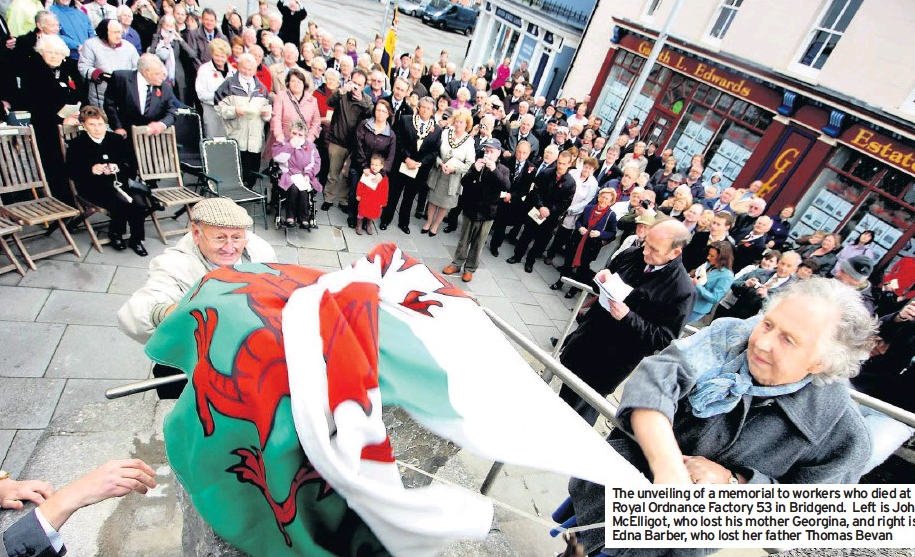
His love of history was given a particularly local flavour when he took a significant interest in the lives of the people, up to 32,000 of them, who worked in the arsenal in Bridgend during WW2. Most of those people were women who were suddenly faced with employment opportunities and a wage – things not necessarily in great supply for women in the ’40s.
Dad wrote a book in 2007, ‘The Welsh Arsenal’, which kick-started a campaign to have the workers recognised for the part they played in the war effort.
Since the book was published, dad has spent countless hours of his evenings and weekends traveling the length and breadth of south Wales to educate others about this unique historical legacy; and to inspire others to take an interest in their own local histories.
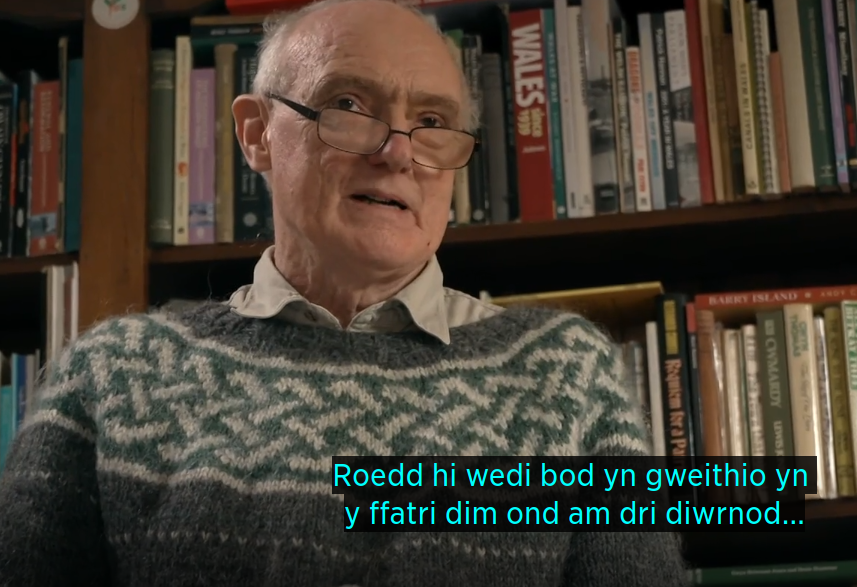
Dad didn’t grow up speaking Welsh; he has learned it as an adult. So it was amazing to see him able to participate in an S4C programme about disability recently. His grandchildren were delighted too (apparently being on telly still has some caché even for kids today!)
My dad’s obvious love of history, and his passion to share it with others, is simultaneously both mundane and extraordinary.
It’s mundane only in the way that, across Wales, hundreds of thousands of us volunteer in our own ways every day, making life a bit better for people in our local communities, or communities of interest further afield. In other words, it’s ‘commonplace, ordinary’.
But what an extraordinary gift of love and mutual cooperation.
From the local history societies, civic societies, local museums, to the environmental organisations that are showing a path to local activism and love of nature, to every form of social, community, health and sporting activity. Our lives are supported by the invisible threads of generosity of spirit, of time, and frequently of money.
You may have heard people say that society doesn’t matter. That only economics matters, only markets matter.
They couldn’t be further from the truth. Not only is the current system broken, using the commons as a convenient place to dump pollution, and harvesting financial wealth as a compensation; but a market-driven approach, with every transaction needing to carry an equivalent monetary exchange, can never provide the rich experiences that humans need to fulfill their true potential.
Next time you hear someone talk about ‘consumers’, remember that they really mean people; and each of us has our own part to play in forging a better society.
The wonderful people who give freely of their time, energy and love are worthy of our huge thanks. So here’s to my dad, Mike Clubb, and to everybody like him who gifts their time within their local communities across Wales and beyond.
I have been bullied in two jobs during a career that has spanned more than twenty years and through a wide range of different organisations.
Pretty good odds, you might think. But those two episodes, totalling around three years, were devastating for my emotional and mental health, and were the two unhappiest periods of my life.
In 2010 I worked at the European Environment Agency, a brilliant organisation although not without its flaws. I was very grateful for being ‘required’ to undertake anti-bullying and anti-harassment training there. It used to be (maybe still is) a requirement for all staff, repeated every two years.
Initially sceptical, I was increasingly drawn into the training that described that, although bullying can happen to anybody, and in any direction (i.e. bosses bullying more junior staff, and even bosses being bullied by junior staff), in general there are certain characteristics that seem to be identified in people who are bullied.
My memory of the training may not be perfect, but my takeaway was that you are more likely to be bullied if:
You are a high performer
You choose unorthodox methods to deliver outputs
You go way above and beyond your remit
You break silos
Feedback I’ve received from other people who have also experienced bullying aligns with this recollection of qualities that are targeted.
One of the statistics that I remember being astonished by, was that in the experience of the training providers, on average around 2-3% of any organisation staff cohort is a bully. This was greeted with amazement by those in the training with me; one participant said:
“So you’re telling me that there are more than five bullies in this organisation?”
The trainer responded elegantly:
“I’m saying that if there are no bullies here, it would be the first example in decades of our experience for an organisation of this size.”
The sad truth is that no organisation, be it public, private or third sector, can consider itself immune from this malady. In my own experience, and to add insult to injury, both the people who bullied me were promoted shortly after I left the organisations, even though the institutions were well aware of my complaints about the way I had been treated.
Even more ironic, one of my bullies was an active participant in the #MeToo campaign at the same time as making my professional life miserable. I guess their outrage didn’t extend as far as an introspective.
Sadly it seems that some organisations devote themselves far more to protecting how they are perceived, and the existing power structures within them, than to supporting people who are experiencing intolerable and unjustified maltreatment.
I’m not an expert on this subject; I can only speak from my own personal experience. But if your ‘spider sense’ starts tingling that something’s not right with how you’re being treated; when you deliver outstanding work but it’s always wrong in some way; when people seem to be going out of their way to try to find things you’re doing incorrectly or wrong (laughably they couldn’t in my case, but that didn’t stop them trying, which was its own form of professional impugnation); then you may be being targeted by a bully.
And again, I can only speak from my own experience, but the outcome of a process of complaints, formal or informal processes; these pile on the personal stress and are not guaranteed to result in any significant change in the relationship or the behaviour.
I found the only way to deal with the issue was to leave the organisations in question. This was a positive thing, as it provided me with a focus for my attention rather than ruminating endlessly on ‘why’, and it empowered me in an environment where I had become very disempowered.
All this is why I felt both sad and proud of my twin brother, Gareth, when he spoke out about being bullied when he worked as Chief Executive of Plaid Cymru. Sad because it’s such a destructive thing to experience; and proud that he could speak out about it, because it has given heart to others who may have thought that their own experiences were unique.
The comments on his post from other people demonstrate that it’s a widespread issue that corrodes and degrades people and performance across all sectors of society.
I was sad to read yesterday that Mick Bates, a former member of the Senedd (back when it was an Assembly) had died.
I knew Mick as a tireless and brave campaigner for renewables during a time when many politicians refused to participate in the debate. It seems crazy now, in the world of climate and nature emergencies, but there was a time in Wales – and in mid-Wales in particular – that renewable energy was something of a pariah topic. Mick was someone who was unafraid to put his head above the parapet, and was a key driver of the main advocacy group in the Senedd at the time – NASEG (National Assembly Sustainable Energy Group).
As someone who was relatively early in their career, I really appreciated the NASEG meetings as an opportunity to travel down from Machynlleth to network with colleagues in Cardiff, as well as to stay with my brother and enjoy a night out. Pretty much all the main policy wonks and practitioners from the sector were at those events, and I remember them fondly. It’s how I got to meet people from organisations as diverse as Dulas, Awel Aman Tawe and Arup.
Mick was a brilliant and inspirational Chair. He played an important role in the renewable energy sector in Wales. I will miss him.









One response to “Linux phones – Ubuntu Touch”
[…] Linux phones – Ubuntu Touch – David Clubb October 16, 2024 […]